A film review by Craig J. Koban April 28, 2011
CINEMA VERITE
 ½
½
 ORIGINAL
MOVIE
ORIGINAL
MOVIE
Diane Lane: Pat Loud / Tim Robbins: Bill Loud / James Gandolfini: Craig Gilbert / Thomas Dekker: Lance / Patrick Fugit: Adam/ Shanna Collins: Susan
Directed by Sheri Springer Berman and Robert Pulcini / Written by David Seltzer
 Reality
TV is such a part of the lexicon of popular small screen culture – for the worse, I would argue – that it’s impossible to
consider a time when TV was not dominated by programs like
SURVIVOR, THE APPRENTICE, THE GREATEST RACE, and so on.
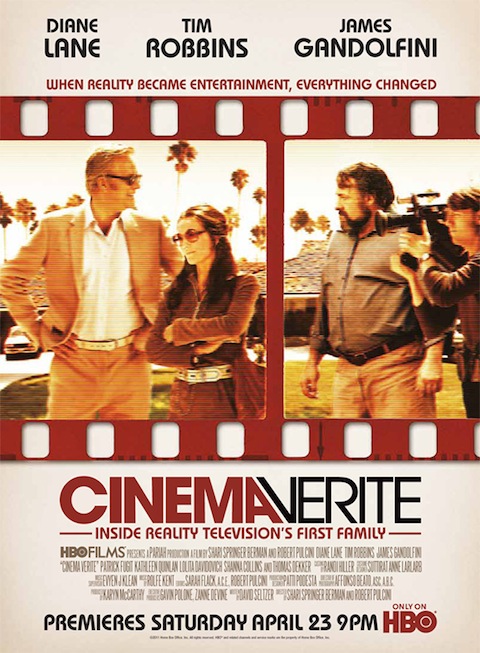
The new HBO telefilm CINEMA VERITE reminds viewers that the
inception of reality TV goes back much further than many may recall.
It was a 1971 PBS documentary called AN AMERICAN FAMILY
- 12 episodes in length and edited from 300 hours of raw footage focusing on
the experience of a typical nuclear American family, the Louds of Santa
Barbara - that can rightfully take claim to fame as being the grandfather
of reality TV shows.
Reality
TV is such a part of the lexicon of popular small screen culture – for the worse, I would argue – that it’s impossible to
consider a time when TV was not dominated by programs like
SURVIVOR, THE APPRENTICE, THE GREATEST RACE, and so on.
The new HBO telefilm CINEMA VERITE reminds viewers that the
inception of reality TV goes back much further than many may recall.
It was a 1971 PBS documentary called AN AMERICAN FAMILY
- 12 episodes in length and edited from 300 hours of raw footage focusing on
the experience of a typical nuclear American family, the Louds of Santa
Barbara - that can rightfully take claim to fame as being the grandfather
of reality TV shows.
The
show was, if anything, a remarkable creative gamble: nothing truly was
ever attempted quite like it. There
have been documentaries before that took a penetratingly introspective
look at their subject matters, but AN AMERICAN FAMILY did something even
more daringly personal: it followed the lives of the Loud family through
their most mundane and consequential aspects of their daily lives, giving
audiences an exceedingly rare you-are-there portal into an ordinary
family unit. The Louds,
however, were anything but a archetypal and run-of-the-mill family:
viewers were shocked to see the series chronicle the fall of the parents'
marriage right before their eyes and were also privy to their flamboyantly
gay son (remember, this was early 70’s TV).
The Louds, whether they aspired to it or not, become notorious
celebrities, something which – in the aftermath of the program –
they came to admonish and regret.
Written
by David Seltzer and directed by Sheri Springer Berman and Robert Pulcini
(who made the splendid AMERICAN SPLENDOR), CINEMA VERITE focuses on the
development, filming, and aftermath of AN AMERICAN FAMILY.
Early on we meet the show’s intrepid creator,
Craig Gilbert (James Gandolfini, very respectable in an against-type role)
approaching network executives about the then unprecedented idea that
would become the first reality TV show, which is difficult seeing as the
terms “reality TV” would not be industry buzz words for 25 years.
After getting the green light, Gilbert finds the
“perfect” family to hone his pioneering documentary on.
He approaches Pat Loud (a poised and rock solid Diane Lane) with his
plans to shoot her family with an all-access, just about anything goes
aesthetic. He
sells her on the prospect that his goals are to perform an anthropological
study of the American family unit, and that rationale – as well, I
assume, the prospect of being TV stars – led to the Loud’s jumping at
the opportunity.
The
documentary film crew - comprised of the husband/wife team of Alan and
Susan Raymond (Patrick Fugit and Shanna Collins) - has some initial
learning hurdles (like, for instance, stopping the shoot just when things
get compelling and personal) and have the obligatory artistic
confrontations with Gilbert, who serves as the grand overseer of the
project. Slowly but surely,
Gilbert begins to chisel away at the false faced of normalcy that the
Louds appear to have and dives deeper into what makes them really tick.
It becomes obvious that the patriarch, Bill (Tim Robbins) is a
publicity seeking hound and a shameless skirt chaser, which causes
seriously ripples in his relationship with his wife, all caught on camera.
Then there is their son Lance (Thomas Dekker, in a breakout
performance), whose clear cut homosexuality caused shockwaves with viewers
and pundits who were not accustomed to seeing gays on TV, let alone in the
reality of a family unit. With
mounting family tensions and the stress of having camera crews meticulous
monitor their daily routines, the Louds slowly begin to implode.
I
think that 1970’s
period films are among the toughest to creatively pull off: too
much garish attention to costume and production design would prove
both distracting and giggle inducing, but CINEMA VERITE finds that
difficult area of giving its story a bravura sense of its time without it
coming off as laughably obtrusive. The
film itself – like many recent HBO efforts – is uniformly well cast
with a series of A-grade performers.
I especially liked Lane’s tricky role as a mother torn between
the allure of fame and the security and privacy of her own marriage.
She amazingly manages to evoke low-key sex appeal with an exhausted
vulnerability. Gandolfini is
good too as Gilbert, a man that must balance artistic imperatives with
romantic ones (it’s implied that he becomes smitten and fixated with
Mrs. Loud). Thomas Dekker
finds Lance’s flamboyant eccentricities and makes him a soulful youth instead of a one-note gay caricature.
Regrettably,
though, CINEMA VERITE does not engage much in the way of social
commentary about the nature of Gilbert’s trendsetting project: the film
just feels underwritten and under-motivated.
What are this film’s thoughts about the ordeal the family went
through? What of the daily
grind of the family being filmed? What
about the notion of whether the project was just or not?
Were there primarily corporate and financial interests at play here
or was the main motivation artistic and going in new avenues that have
never been taken before on TV? And
what of the creator himself? Can
a creator of a program such as this truly separate his personal feelings
from his subject matter that he has become so deeply personal with?
CINEMA VERITE seems to drop the ball entirely with sincerely
focusing on these very questions, not to mention that with its scant 90
minutes it does not have sufficient time to explore what it would be like
to be the subject of a 24/7 documentary.
Two
other aspects seem ignored or haphazardly developed: Pat Loud has been
often referred to as a feminist role model for how she decided to leave
her philandering hubbie, but part of the film’s problem is that
Robbins' Bill is such a one note creation that the build up to her
divorcing him lacks a rousing payoff.
Considering the importance of the show in the annals of TV history;
CINEMA VERITE just becomes a melodrama about a nice woman stuck with a
jerk that she eventually leaves. The
second problem with the film is with its presentation of Gilbert himself:
Gandolfini is fine, to be sure, but the writing betrays his strong
work. Was he a liberated and inventive artistic genius or was he a
self-serving, egomaniacal, publicity-seeking scoundrel?
The teleplay here can’t decide.
We do learn that he never made another film after AN AMERICAN
FAMILY…but why? CINEMA
VERITE never provides sufficient answers.
Aside
from the film running too short and having a lamentably scattershot focus
on its characters and themes, CINEMA VERITE does not really enrich the
legacy of the seminal PPS mini-series whose ripples can still be felt
today. There’s no sensation at all as to why this show was
important, other than the fact that the film's title cards tell us that
Gilbert invented reality TV. And
what of the show’s long gestating legacy?
Why did it take oh-so-long for this genre to become as ubiquitous
as it is now? CINEMA VERITE
is well acted and produced, but it lacks a compelling follow-though with the
underlining material. I have
covered and have been a staunch supporter of HBO films since 2008 (some of
the best films of the last few years, big screen or not, have seen the
light of day on this network, like RECOUNT, TEMPLE
GRANDIN, YOU DON’T KNOW
JACK, and THE SUNSET LIMITED),
but CINEMA VERITE represents a rare missed opportunity for the them that has
made a steady habit of making a series of reliably strong
entertainments.
CrAiGeR's other
|
|

Film Reviews:
RECOUNT
(2008)

TAKING
CHANCE (2009)
 1/2
1/2
TEMPLE
GRANDIN
(2010)
THE
SPECIAL RELATIONSHIP (2010)
 1/2
1/2
YOU
DON'T KNOW JACK
(2010)
THE
SUNSET LIMITED
(2011)
TOO
BIG TO FAIL (2011) 1/2
GAME
CHANGE
(2012)
HEMINGWAY
AND GELLHORN
(2012)
1/2
THE
GIRL
(2012)
PHIL
SPECTOR (2013)
BEHIND
THE CANDELABRA (2013)
CLEAR
HISTORY (2013)
