A film review by Craig J. Koban November 10, 2010
CONVICTION
 ½
½
Hilary Swank: Betty Anne Waters / Sam Rockwell: Kenny Waters / Minnie Driver:
Abra Rice / Melissa Leo: Nancy Taylor / Peter Gallagher:
Barry Scheck / Juliette Lewis: Roseanna Perry / Ari Graynor:
Mandy Waters
Directed by Tony Goldwyn/ Written by Pamela Gray
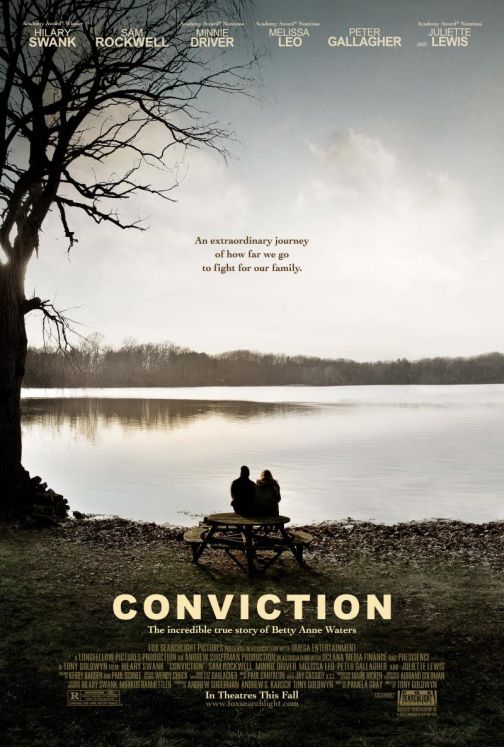
CONVICTION tells a story of a most courageous and heroic sister. Betty Anne Waters (Hilary Swank) is a working class woman that came from a terribly rough lower class childhood. She and her brother, Kenny (Sam Rockwell), had an absentee father and a mother that shirked her paternal responsibilities so much that her children were forced into a series of depressing foster care homes. Yet, for as much personal anguish as the siblings found themselves in, they nonetheless formed a strong, lifelong bond that allowed for them to persevere. The two would really have to persevere when an adult Kenny is found guilty of murdering a local woman and is sentenced to life in prison. The sister, convinced that her brother is innocent and has been wrongfully prosecuted and imprisoned, takes it upon herself to find a way to free her beloved brother, and she spent a large portion of her life doing so.
Kenny’s trial perhaps ended as
soon as it began: the family could not afford a very good lawyer to help
defend him and when he was put in prison they certainly could not
afford another lawyer for the lengthy
appeal process.
Without much in the way of options, Betty Anne decided to go to
obsessive lengths to ensure that her brother got his freedom from
incarceration. Not only did she finish high school (she was a drop
out), she also went on to college and then put herself through law school, all
in an selfless and determined effort to become her brother’s own legal
representation and find the necessary evidence that would free him once and
for all.
She did all of this while baring the burden of huge personal
sacrifices: she saw her marriage degenerate before her eyes and became a
kind of absentee mother of her own kids that was an eerie reflection of her own mother.
Nothing, however, would deter Betty Anne from securing her
brother’s freedom, even if it meant being dealt with one personal
roadblock and setback after another.
Her journey did not occur overnight either: freeing her brother
consumed her and took prominence over every other concern.
CONVICTION is one of those
“triumph of the human spirit to overcome all obstacles” fact based
movies that, thankfully, does not sanctimoniously browbeat audience
members ad nauseum for two hours with its hooky sentimentality.
Unlike last season's late fall true story offering, THE
BLIND SIDE, CONVICTION’s reality based inspirational tale is
handled with just the right tact, restraint, urgency and poignancy.
It seems genuinely less interested in shamelessly manipulating
viewers’ emotions than it does with giving a fly-on-the-wall chronicle of
Betty Anne's struggles to exonerate her brother.
The Sandra Bullock persona in THE BLIND SIDE, a woman of wealth and prosperity,
was revered for being a hero for coming to the rescue of an
impoverished African American lad, but Betty Anne’s valor reaches
a whole other stratosphere: here is a poor woman that suffered, in one form or
another, throughout her childhood and adulthood and forfeited a large
chunk of her life in order to help the family member that meant the most
to her.
Yes, Kenny definitely suffered in prison for a crime he did not
commit, but his sister went through a whole other type of painful ordeal
on the outside.
The film takes an interesting
narrative trajectory right from the get go: The non-linear chronology is
at first a bit jarring, but it creates more symmetry as it progresses,
showing flashbacks within flashbacks that provide an account of Betty Anne
and Kenny’s life together.
The story opens with the aftermath of a ghastly 1980 murder of
Ayer, Massachusetts-residing Katharina Brow.
A locale police officer, Nancy Taylor (Melissa Leo) already has her
sights set on Kenny as the main suspect, and even though the evidence
against him is initially very circumstantial, his less than sterling town
reputation for being an unruly thug has made him a frequent target of the
police.
As the film flash forwards to 1983 new testimonial evidence is
brought to light that proves to be a damning indictment of Kenny’s
guilt, which leads to his imprisonment.
Betty Anne did not take this lying
down, even during the really tough times when a hopeless minded Kenny
attempted suicide in prison.
She would get her GED, then a Bachelor’s degree, a Master’s in
Education, and eventually a law degree from Roger William’s University
in Rhode Island…all while Kenny waited patiently behind bars.
Betty Anne, once unemployed with no high school diploma, achieved
all of her scholastic success while getting married and mothering two
children while waitressing at a bar to earn end's meat.
Part of the fascination I had with CONVICTION is the way it
presents this woman as one with a steadfast passion to put her own needs
off to the side and place her brother’s front and center.
I don’t know of too many sisters that would have gone to her
lengths to help a sibling in need, and if her story were not true then
CONVICTION would have been a hard pill to swallow.
Yet, her story is indeed a true one, and after a grueling and
exhausting 16-year legal odyssey, Betty Anne managed to free her brother
with the tireless assistance of a law school friend (Minnie Driver) and
Barry Scheck (Peter Gallagher) a lawyer that heads The Innocence Project
that uses DNA evidence (not available in the early 80’s) to free
wrongfully convicted men.
CONVICTION is quarterbacked by its
two lead performances by Swank and Rockwell that unobtrusively begs for
serious Oscar consideration.
One thing that the pair does with such a raw naturalness is to
suggest a long and calamitous history between the two of them.
There is rarely a moment in the film when you don’t implicitly
believe that these two people are brother and sister, and that type of
lifelong bond is kind of thanklessly created within these performances.
Swank has always been a commanding and headstrong actress, and her
no-nonsense and freshly economically turn as her mother turned detective
turned lawyer is her finest work since MILLION
DOLLAR BABY.
What’s ultimately so compelling about Swank’s choices here is
that she does not make Betty Anne an instantly agreeable person, nor is
she one that is naturally gifted (she was not intrinsically intelligent;
she really had to work through college to graduate and certainly was not
immediately a legal force to be reckoned with afterwards).
Swank evokes a woman of fearless, headstrong drive, which make up
greatly for Betty Anne's other limitations.
Rockwell, on the other hand, has
perhaps the trickiest performance of the pair to pull off effectively as
the rambunctious, hot-tempered, quietly strong, but ultimately melancholic
and vulnerable Kenny.
Rockwell has always been a secured and underrated performer (look
at last year’s MOON) and the emotional
spectrum he has to capture as his convict is considerable: he shows Kenny
as a loudmouthed man with a cocky swagger that then, as his
life behind bars gets the better of him, is shown gradually crumbling
into someone who believes that life has completely trampled on him.
What’s important is that Rockwell never oversells Kenny as a man
that instantly deserves our innate sympathy, nor does he show him
as a one note victim.
Kenny is presented as a loose cannon and person that did less than
innocent things in his life, but he certainly was innocent of his crimes.
Rockwell is an absolute dynamo for showing this layered character’s
traumatic progression throughout the film. Plus, has there been a
better modern actor that has not be nominated for an Academy
Award?.
There is one other superlative
performance in the film during two short, but memorable scenes featuring
Juliette Lewis that perhaps gives the cameo of the year as a
trailer-trash, alcoholic, and miserable ex-girlfriend of Kenny’s that
may or may not have perjured herself to get him convicted (watching her
totally command attention during an extended confessional late in the film
is sort of freakishly impressive).
The direction of CONVICTION by Tony Goldwyn (who filmed one of Paul
Haggis' most underrated scripts in 2006's THE
LAST KISS) is also finely nuanced and appetizingly free of falling
victim to clichés or melodramatic flourishes.
He intuitively knows that the best way to let this factual material
really fly is to avoid thematic grandstanding and dramatic soppiness; he let's the exceptionally well-tailored and credible performances sell
the story.
There are a few minor weakness with
the film along the way, though: Melissa Leo is solid as a wickedly
duplicitous cop that went to unethical levels to see Kenny put away for a
lifetime, but her character is not truly developed much more beyond that
(there surely could have been more interest in this flawed person beyond
the superficial guise of a “bad cop”).
That, and CONVICTION rather oddly ignores a prevailing tragedy of
Kenny’s post-prison life: he died from a head trauma a scant
six months after he was freed, which certainly must have been a highly
frustrating blow to the Waters family at the time.
Yet, CONVICTION is not concerned with the story after Kenny’s
prison stay, but rather the circumstances that led to his imprisonment and
the arduously self-sacrificing tribulations that his sister went rough for
nearly two decades to free him.
Because of that, CONVICTION surprisingly rises well above my
expectations as a sappy and sugar coated feel good drama of the human
spirit; it’s far more subtly moving and compellingly rendered than that.
