A film review by Craig J. Koban July 8, 2010
THE CRAZIES
 ½
½
Sheriff: Timothy Olyphant / Judy: Radha Mitchell / Deputy: Joe
Anderson / Becca: Danielle Panabaker / Deardra: Christie Lynn
Smith / Bill: Brett Rickaby / Nicholas: Preston Bailey / Mayor:
John Aylward
Directed by Breck Eisner/ Written by Scott Kosar and Ray
Wright based on the 1973 film by George A. Romero.
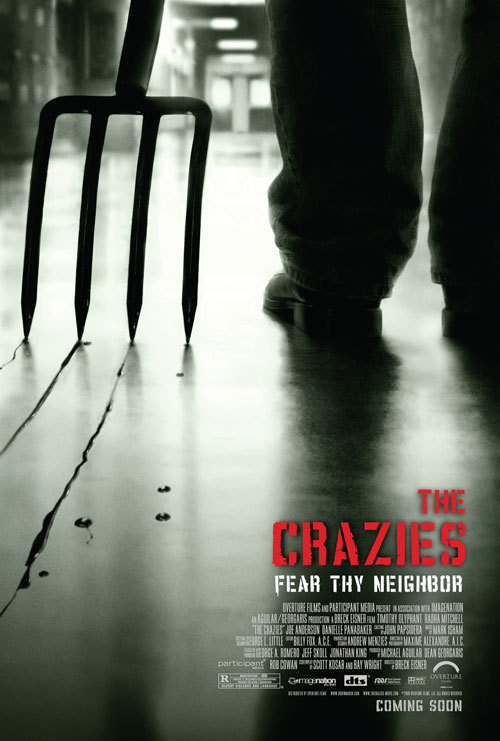 THE
CRAZIES is an uncommonly tense, disturbing, and lean and
simply directed horror/thriller. This
is a welcome thing. Too many modern splattergoriums of visceral mayhem and
carnage seem more prone to wowing us with bombastic sensory overload. The great thing about THE CRAZIES is how low key and efficiently
directed it is: Yes, it takes a premise that is woefully familiar and has
been done a million times before (man-made plague turns ordinary people
into humanity-hating zombies on the verge of a social apocalypse), but it
takes that dime-a-dozen concept and infuses it with sparse, but evocative
atmosphere, a strong sense of relentless tension and dread, and a minimalist
aesthetic approach that far too many young filmmakers that
worship at the alter of Michael Bay seem incapable of mustering.
THE
CRAZIES is an uncommonly tense, disturbing, and lean and
simply directed horror/thriller. This
is a welcome thing. Too many modern splattergoriums of visceral mayhem and
carnage seem more prone to wowing us with bombastic sensory overload. The great thing about THE CRAZIES is how low key and efficiently
directed it is: Yes, it takes a premise that is woefully familiar and has
been done a million times before (man-made plague turns ordinary people
into humanity-hating zombies on the verge of a social apocalypse), but it
takes that dime-a-dozen concept and infuses it with sparse, but evocative
atmosphere, a strong sense of relentless tension and dread, and a minimalist
aesthetic approach that far too many young filmmakers that
worship at the alter of Michael Bay seem incapable of mustering.
This
new CRAZIES is based on the original 1973 film of the same name by the
godfather of the cinematic zombie genre, George A. Romero.
That film, much as this new one does, focuses on the dangerous
after effects of the accidental release of a military-created biological
virus on the citizens of a small American town.
The original movie was
one that I remembered for having a decent hybrid of divergent themes: it was
part zombie horror-fright flick, part commentary on the nature
of biological warfare, and part conspiratorial thriller on the
nature of U.S. military power gone horribly afoul.
Romero’s original was a decent entry in the genre that he spawned, but
a horribly poor distribution plan in the early 1970’s left it
largely off of the radar of filmgoers for its time.
Romero
now serves as a producer for this new, updated version of his original
story, which is now directed by Breck Eisner (SAHARA), who clearly
understands and tries to appropriate what made Romero’s past horror
films so efficient and effective. Instead
of engaging in a potentially nauseating utilization of CGI overkill and
employing hyper-spastic editing that inspires seizures (far, far too
common in today’s action and horror films), Eisner keeps THE CRAZIES
remake down to its stylistic essence. Despite its higher budget
and bigger scope than its predecessor, this CRAZIES-redux manages to resourcefully remake the
original story while paying homage to the B-grade, low budget spirit of
Romero’s work. The
temptation here easily could have been to amp up everything, but Eisner
wisely knows not to fall victim to lame visual gimmicks and tricks: no
queasy cam, no eye-straining, split-second editing, and no heavy preponderance of
computer fakery. All
of this makes THE CRAZIES feel more authentic and tactile.
The
film does an exemplary job of quietly establishing the bucolic atmosphere
of its small town setting before all zombie-hell breaks loose.
It opens in the tiny and close knit farming community of Ogden Marsh, Iowa that
is the home to a young police sheriff named David Dutton (Timothy
Olyphant) and his loving wife, a family doctor named Judy (Radha
Mitchell). Both of them have
their respective assistants: David has his deputy, Russell (Joe Anderson) and
she has her teenage assistant, Becca (Danielle Panabaker).
The small town that surrounds these people is as ordinary as they
come: quaint, friendly, and inviting.
Everything
changes one spring day when David decides after work to attend a local
high school baseball game, during which something very, very unexpected
happens. During one inning his deputy spots a peculiar sight: one
of the townsfolk, Rory Hamill, enters the field…packing a shotgun.
He has a reputation for being a drunk, so David wisely decides to
confront him in the outfield, but Rory seems eerily uncommunicative to
even the simplest of David’s questions.
Things turn deadly when David is forced to shoot Rory dead when it
appeared that Rory was about to fire upon him.
David clearly feels an extraordinary sensation of guilt and unease
about the whole situation, but his caring wife smartly reassures him that
he did what he had to. However, David becomes even more paranoid when he gets the
pathology report of the slain Rory: despite appearing outwardly
intoxicated, his blood alcohol level before he dies was…0.0.
This
is…well…odd. It becomes
even odder when Doctor Dutton begins to notice disturbingly similar symptoms
that Rory exhibited in some of her own patients (one in particular is so “sick” that he manages to trap his wife and young
child in his farm home and burns them alive).
This is clearly…not normal behaviour, and soon David and his
deputy begin to take it upon themselves to find out what the h-e-double
hockey sticks is going on. Without
given too much away, it appears that the cause of the…odd
behaviour in
the townsfolk is incontestably linked to the government and military, but
David and his partner find all of this out too late.
Within no time, a majority of the citizens become zombified as
unthinking, sociopathic killers.
The
full force of the U.S. military does swoop in and places the entire town
under strict quarantine protocol, seeing as the epidemic is getting
way-out of control. The affected people are rounded up in medical interment camps
and quickly disposed off, whereas all of the healthy people are being
escorted out of the city. It
becomes really alarming when the military falsely suspects David’s wife
as being sick (her fever is pregnancy related) so he bravely decides to re-enter the
dangerously plagued and inhospitable town to save his wife…that is unless he
can get around the “crazy” townspeople and the very trigger
happy soldiers that have been instructed to shoot first and not ask
questions later.
I
have typically found most movie zombies to be quite comical.
They do, after all, lurk at an elephantine pace, grunt and groan,
and willfully offer themselves as easy targets to their human enemies that
make mince meat of them with a variety of hilariously improvised weapons.
The zombies (if you can indeed call them that) in THE CRAZIES are
actually sort of frightening entities here: they are mindless, salivating
killers, to be sure, but there is just something uneasy and chilling about
seeing these infected people slowly and methodically murdering people and
then acting like they’ve done nothing wrong (one “crazy” does a
self-congratulatory whistle while staring blankly into dead space after one
of his vile acts).
Eisner’s
refreshingly sparse and unflashy directorial style, as mentioned, works
wonders here. Using dark and macabre cinematography by Maxime
Alexandre (he
paints the shots with blacks and greenish hues to heighten the menace)
and clean and precise editing by Billy Fox that does not overwhelm you,
Eisner knows how to pool his talents together to generate palpable tension
and reasonably decent “boo!” moments.
He also intuitively knows how to linger on well-composed
compositions and juxtaposing them with a sickening soundtrack to foster an evocation of
hostile unease. Then there
are some of the remarkably nifty and innovative action sequences. We have many of the obligatory moments involving David et all
picking off various “crazies” with equally obligatory weapons
(pistols, rifles, cars, etc.), but just watch how creepy, unnerving, and
freakishly intense Eisner makes one scene involving the survivors in an
old police cruiser while at a car wash.
I love it when a filmmaker can take redundant settings and make
them scary: your next trip to clean your ride may never be the same
after seeing this film.
The
performances are all just as expediently underplayed as the direction.
Olyphant, always a cool and collected screen presence, plays his
sheriff character with the right blend of gutsy bravado and fingernail
chewing agitation. Radha
Mitchell, a naturally beautiful screen presence, is headstrong and
vulnerable in what easily could have been the perfunctory damsel-in-distress wife role. I also
appreciated the work of Joe Anderson as the increasingly deranged deputy,
and his performance slyly hints at a possibility of plague infection…but
we are never really quite sure.
The
key here is that Eisner keeps his players grounded: they all resist the
temptation to overplay and oversell their performances, even when they are
called upon to be physically horrified at their predicament.
If there were to be a weakness in THE CRAZIES then it would be in its usage of the military as a secondary antagonist to the “crazies” themselves. The ’73 Romero-classic had a sharp and subversive political vibe to it, which has largely been neutered in the new incarnation (the military is certainly initially portrayed as heartless and cold, but considering the circumstances of the plague, would they really act any other way when containing a potential worldwide epidemic?). Romero has been known as a filmmaker that has used his zombie films as acerbic social commentaries as well, and there certainly was an opportunity for the new CRAZIES to perhaps be a reflection of the H1N1 scare pandemic that polarized most of the world during its release earlier this year and last fall. These are small quips, because THE CRAZIES still emerges as a surprisingly well-made remake: edgy, exciting, genuinely thrilling, and – most crucially - modestly shot without self-indulgent overstatement. Trust me, it's all the more involving and fearsome for its less-is-more artifice.
