A film review by Craig J. Koban January 4, 2011

Rank: #12
THE KING'S SPEECH

King George VI: Colin Firth / Lionel Logue: Geoffrey Rush / Queen
Elizabeth: Helena Bonham Carter / King Edward VIII: Guy Pearce / Winston
Churchill: Timothy Spall / Archbishop Lang: Derek Jacobi / Queen
Mary: Claire Bloom / King George V: Michael Gambon
Directed by Tom Hooper / Written by David Seidler
 How many inspirational films
about underdogs overcoming immense personal odds to achieve ultimate
personal victory do you recall where the underdog in question is a wealthy
member of the British monarchy?
How many inspirational films
about underdogs overcoming immense personal odds to achieve ultimate
personal victory do you recall where the underdog in question is a wealthy
member of the British monarchy?
Not many that I can recall,
but Tom Hooper’s THE KING’S SPEECH is just one of those films, and if
it were not based on real events and personas it might have been a tough
story to accept. We have all seen innumerable examples of these types of
uplifting chronicles of societal fringe characters realizing their own
inherent personal potential to achieve their goals, but THE KING’S
SPEECH throws a curve ball at audiences by how heartfelt and honest it is
with presenting its story of a very famous and very powerful man that
finds the courage and determination to help himself.
It also manages to traverse over two hemispheres: it’s not only a
sweeping and virtuoso historical drama, but also an intimate and poignant
story of a highly unlikely friendship.
The historical figure in question in the film is King George VI (played in the film by Colin Firth), who ruled over the United Kingdom from 1936 until his death in 1952. He was a very unlikely King: his brother Edward VII ascended to the throne in 1936, but less that a year later he stepped down due to his controversial and highly problematical relationship with an American socialite. Thusly, George VI became the newly anointed King and became one of the most commanding figures in Europe.
He did
have one major problem: he was a chronic stammerer.
George VI was generally not a
healthy man outside of his linguistic problems:
He was a sickly person all through his childhood, easily frightened
and prone to tears, and his aristocratic parents hardly made a
personal dent or impression in his young life.
His stammering began around in his early childhood, which was
exacerbated by other issues: he was forced to write with his left hand,
even though he was right handed and he was afflicted by chronic stomach
aliments and knock knees, for which he was required to wear highly painful
splints. This was hardly a
lifestyle befitting a man of affluence; this future King had it rough.
Of course, well before he
became King he was Prince Albert, the Duke of York that was married to Elizabeth
(the future Queen) and had two daughters (Margaret and Elizabeth, the
latter whom become the second Elizabeth Queen, after her mother) and even
though he was a loving father and husband, he dreaded public life due to
his speech impediment. Although
he kept his affairs quite private, his stammering became a subject of
public record during a disastrous speech he attempted to give at Wembley
Stadium in October of 1925 (the film’s opening scene).
Realizing that any future as a member of the Royal Family would
preclude more public speaking endeavors, The Duke decided that enough was
enough and sought help.
His initial forays into
medical assistance are failures, which left Prince Albert defeated.
However, Elizabeth (Helena Bonham Carter) take matters into her own
hands by seeking out a notable Australian speech therapist named Lionel
Logue (Geoffrey Rush), who developed unorthodox, but successful treatments
of shell shocked WWI vets by using physical exercises, vocal therapy, and
some much needed understanding and compassion.
When Elizabeth comes to his office he is not aware of her or her
husband’s position; when he asks probing questions, like “Is he an
indentured servant?” she responds, “Something like that.”
When Prince Albert does
finally meet Lionel, there are some obvious awkward tensions, the first
being that Albert does not like being in therapy outside of Buckingham
Palace and the second being that the high standing of his client surprises
Lionel. However, much to
Prince Albert’s chagrin, Lionel persists to treat him like he were any other
normal client, which involves dissolving any unnecessary formalities (like
referring to him as “Your Royal Highness”; Lionel opts of
“Bertie”).
After these initial tensions,
Lionel begins to grasp a fuller picture of the Prince’s issues: he
recognizes problems with his larynx and diaphragm and begins to prescribe
daily exercise to work key areas of his body, not to mention that he made
ingenious use of tongue twisters, songs, and calming measures to ensure
that the Prince’s vocal hesitancy was reduced.
Slowly, but surely, the Price becomes a more nuanced and assured
speaker, but his progress regresses after his personal family life begins
to unravel with his brother Edward’s (Guy Pierce) ascending to the
throne and his eventual stepping down, which left the Prince with the
daunting and intimidating task of being the new King of England and facing
a lifetime of speeches not only in public, but on the then flourishing
medium of radio. Lionel does
help the new King through his coronation, but when the former Prince
turned King George VI is forced to
give a ten minute radio address to the entire nation about Germany’s
declaration of war, Lionel realizes that he will have to pull out all the
stops to ensure that this speech is not a retread of the
calamitous 1925 Wembley Stadium speaking debacle.
73-year old David Seidler, a
TV veteran who was a former stammerer and clearly has a great compassion
and sympathy for the plight of the King, wrote the screenplay for THE
KING’S SPEECH. His script sort of strictly adheres to the basic formulas for
this type of overcoming-all-odds pictures while, at the same time, making
the film feel fresh and unique because of its historical underpinnings and
choice of subject matter. His
presentation of the Duke-turned-King is not squeaky clean by any
assertion: George VI is shown
as a man
of pomposity at times when it comes to his title, position, and the
respect he believes it automatically deserves, but he is also written as
vulnerable, emotionally wounded, and sympathetic figure worthy of our
understanding. The fact that
he was a filthy rich and prosperous King is almost beside the point: he was
a man that suffered from a hellish vocal condition that ate away at his
confidence and self-respect and the friendship he formed with Lionel shows
the great steps he took in placing his trust in a complete commoner and
stranger. Lionel too is also
a multi-faceted character: he puts on a false image of
confidence and poise in helping the King, but even he underneath it all is
overwhelmed with the prospect of helping royalty. He too has a personal journey of obstacles to overcome as
well.
The film’s director is
37-year-old Tom Hooper, who directed episodes of the terrific HBO JOHN
ADAMS mini-series and made one of the most quietly compelling,
behind-the-scenes sports pictures of last year in THE
DAMNED UNITED. He
creates not only a sense of refined and immersing period design in THE
KING’S SPEECH, but he also fosters a mood of immediacy and intimacy the
sort of lurches up on you in unexpected ways.
He finds a visual manner of reiterating the personal trials and
tribulations of his characters and their insecurities: he uses ample medium and close up shots, often off center, which heightens the initial
uncertainty of both Lionel and the King’s relationship.
In the film’s thrilling and rousing climax, Hooper patiently and
confidently evokes how simple things like a walk down a tight corridor or
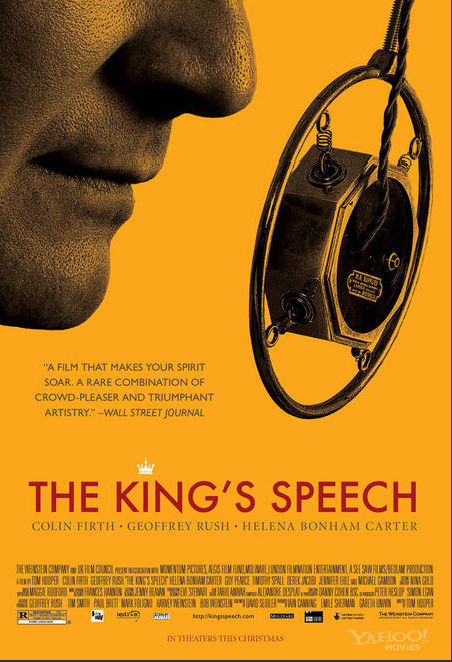
approaching a large microphone - which is really the film’s villain,
especially as far as George VI is concerned – creates a looming sense of
dread and anxiety for the therapist and his patient.
At this point the film has you're completely in its grasps and do
not want to be let go.
THE KING’S SPEECH is a
dreamscape of outstanding performances.
The small ones hit just the right notes, like Guy Pierce as the
somewhat prissy and pathetic Edward or Helana Bonham Carter’s humanistic
take on Elizabeth’s headstrong and nurturing disposition.
Michael Gambon is memorable in a very brief role as George V, who
before he dies in the film gives his poor ol’ son a tongue lashing when
he stammers though his speech practices.
THE KING’S SPEECH is owned,
though, by the likes of Colin Firth and Geoffrey Rush, whose portrayal of
both the King and speech therapist respectively will sure to net Oscar
nominations. Firth - a celebrated, if not a bit under-appreciated British
actor – not only believably and sensitively creates the King’s
maddening stammering (which, under a lesser actor’s hands, could have
been manically overdone), but he also rounds off the King as a man of both
fiercely introverted stubborness while imparting in this larger-than-life
public figure a sense of humility and helplessness that makes us empathize
with him and root him on to the challenges he faces.
Rush is also a marvel to behold as he makes Lionel both deviously
sly, shrewdly intelligent, and compassionate towards George VI.
Rush’s gentle and calm-spoken interplay with Firth makes their
pairing one of the best of 2010. He
also occupies some of the film’s most absurd comic scenes as he
convinces the King to lose all sense of decorum during one session an
engage in a litany of f-bombs.
The end title credits informs us that Lionel and George VI remained lifelong friends until the King died, he even extended his gratitude towards him by inducting Lionel into the Royal Victorian Order in 1937. The central friendship is the key to the greatness of THE KING’S SPEECH, and the performances, writing, and direction all work in tandem to immerse us within this friendship that spanned a lifetime. Some critics bemoan that THE KING’S SPEECH is one of those artificially created, feel-good true stories ready-made for Oscar nomination season. Yes, the film is steeped in routine conventions, but it’s quietly and unassuming powerful for the emotions it stirs with regards to its story. We intuitively feel George VI’s view of weakness, dismay, and a lack of self-efficacy and it is the universality of these themes that makes THE KING’S SPEECH rise far, far above formula.
| REVIEW ADDENDUM |
THE KING'S SPEECH has been ridiculously rated "R" by the MPAA. Let me make this clear: this film contains no sex, no hard core or gratuitously gory violence, and little, if any, innuendo. The R-rating comes from the few scenes where GEORGE VI, while in therapy, unleashes an expletive-laced rant to loosen himself up. Seriously, this film is age-appropriate for any young teen viewer that has heard this type of language many times before.
