


 A
film review by Craig
J. Koban April
7, 2022
A
film review by Craig
J. Koban April
7, 2022
LUCY
AND DESI 
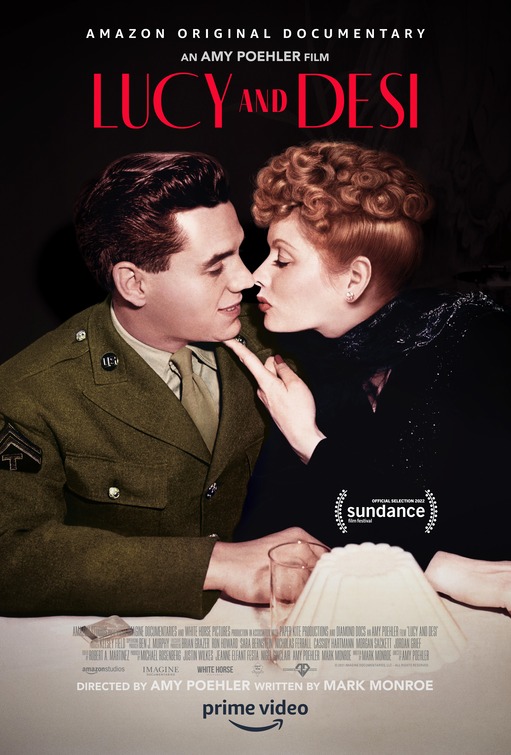
A documentary directed by Amy Poehler and written by Mark Monroe
|
|
|
ORIGINAL FILM |

Amy Poehler's intoxicating Amazon Prime documentary LUCY AND DESI aims to do two things (and it does so resoundingly well):
Firstly, it wishes to tell a touching love story about two of the most iconic figures in sitcom television history in Lucille Ball and Desi Arnaz. Secondly, the doc chronicles what a truly pioneering couple they were when it came to pushing the boundaries of what the then new format could do on top of showing Ball as an absolutely fearless comedian that took her job seriously with a near surgical precision.
Many will be
wondering whether or not LUCY AND DESI is required viewing after the
streaming giant just released their Oscar nominated drama BEING
THE RICARDOS, but both manage to compliment each other rather
nicely (granted, Poehler's doc is more ambitious in its scope and focus).
Aaron Sorkin's 2021 film - a fine accomplishment in its own right -
narrowly honed in on a very stressful week in the making of one of the
episodes of I LOVE LUCY, whereas LUCY AND DESI digs deeper behind this
power couple's formation, their formative creative years together, and the
collapse of their marriage due to the strains of putting on show.
It's impossible
to understate just how popular I LOVE LUCY was in the 1950s.
The most cherished episodes of the sitcom were watched by upwards
of nearly 70 per cent of Americans of the day.
The very first issue of TV Guide featured an image of Ball and
Arnaz's first baby, with the former's real-life pregnancy being written
into the show (a taboo-breaking occurrence in the history of television).
One of the questions that I had going into LUCY AND DESI was what,
if anything, could this doc tell me about these inordinately influential
TV personalities that I didn't already know?
Thankfully, Poehler doesn't resign herself to an obligatory talking
heads/archival approach (even though the film does contain both).
Revealed early in the doc, a series of cassette tapes provided by
Ball and Arnaz's daughter (also an interview subject here) gives us
intimate, never before heard conversations, daily musings, interviews, and
so forth that provides a portal into the past and allows the couple to
almost narrate this doc from the grave.
Of course, Poehler manages to get some modern interviews from a
variety of participates (including other industry titans like Norman Lear
and Carol Burnett), but the real holy grail material here is hearing Ball
in particular speaking with remarkable frankness about various aspects of
her life and career, both good times and bad.
The wealth of material here is pretty amazing and revelatory.
The doc serves
its purposes of giving us a sense of this couple's personal history
together as well, explaining how the two met back in 1940 on an RKO
musical called TOO MANY GIRLS (Ball began her career as a model in the 30s
that later begat a career on Broadway that, in turn, segued into her
becoming a contract player for RKO, mostly as a chorus girl working in
B-pictures). Arnaz, at the
time, was already a well established and popular Cuban-American bandleader
when he courted Ball, but shortly after they were married his career
started to freefall, which led to him joining the army for three years
(this was followed by going back on the road as a musician, to which Ball
claims that her hubby was gone 99 per cent of their marriage).
As history has shown, their greatest creative coup for them came
with conceiving a sitcom where they could play slightly fictionalized
versions of themselves, and it's here where the doc rightfully cements
this pair's rightful place as watershed figures that made something that
was then extremely cutting edge. Just
consider, for starters, the notion of having a mixed race couple
headlining a new sitcom in the 50s. That
alone was extraordinarily forward thinking and, in the era, extremely
controversial (the network original wanted nothing to do with this
concept, but Ball not only wanted to push the envelope of standards and
practices, but also - on a practical level - wanted her husband home and
working with her as opposed to doing the nightclub circuit on an endlessly
loop).
|
|
The doc also
wisely points out that for as much unbridled ambition that Ball had as a
comedic performer (and as a meticulous perfectionist), Arnaz deserves
credit for insisting that their show to be shot on film to visually
preserve it longer and for future generations.
Ball herself - via interview snippets and her musings on those
aforementioned tapes) is monumentally modest about her own gifts as a
comedian. When you watch
episodes of I LOVE LUCY her gifts as an on-screen funny lady seem both
effortless and natural, but by her estimation what made her character and
the laughs work was approaching them with an almost scientific level of
scrutiny. She's also
remarkably hard on herself in terms of her beauty ("If you're not
beautiful and you're not bright you can do anything").
What became so alluring about her portrayal of the most famous
redhead in pop culture history is in just how plucky she was at making
herself look bad on camera for a gag.
She describes it as an "enchanted sense of play":
Lucy on I LOVE LUCY felt like a real person despite the madcap and
sometimes frankly bizarre things that happened to her.
That's what made her so unendingly loveable, and her command of
physical comedy deserves worthy comparisons to the work of Keaton or
Chaplin.
LUCY AND DESI
also focuses on the aftermath of the duo's iconic series, which lasted a
modest five seasons and 179 episodes.
In a bold business move, they sold the rights for $5 million (an
gargantuan for the 50s), which gave way to their show being
"rerun" for as long as time would permit.
With their wealth and power, Ball and Arnaz set their crosshairs on
bigger aspirations, like purchasing the studio that started Ball's career
in RKO, which they affectionately renamed Desilu (something that's largely
forgotten is that their newly christened studio went on to produce the
original STAR TREK and MISSION: IMPOSSIBLE...and just imagine the entire
pop culture landscape without Gene Roddenberry's creation in collaboration
with Desilu). The weight of
industry pressures did get the better of Ball and Arnaz, which led to
their fairy tale romance and marriage coming to an abrupt end with divorce
in 1960. Ball herself
became the very first woman to run a TV studio with Desilu in 1962.
I think that the
one area that Poehler's feel-good doc misses the mark is in covering
Arnaz's well publicized drinking and womanizing, which, no doubt, was a
prime catalyst for their depressing break-up (if anything, the doc oddly
seems to emphasize that it was Ball's greater success as the face of I
LOVE LUCY that made Arnaz envious). In the aftermath of their divorce, Arnaz became obsessed with
becoming a prominent producer on his own, which regrettably started him on
a downward path (when all is said and done, he never attained the
instantly recognizable status of his more beloved wife in the public eye).
Arnaz was tragically diagnosed with lung cancer in 1986 after a
lifetime of smoking, but in one of LUCY AND DESI's most poignant reveals
their daughter in Lucy Arnaz Luckinbill explains how her mother went to
visit her father while he was on his death bed and - to numb his pains -
they watched old reruns of I LOVE LUCY and joyously laughed all the way
through them. Ball and Arnaz
didn't end up working as a compatible couple in life, but on TV they made
something legendary that would live in our collective hearts and minds
forever.
