A film review by Craig J. Koban February 2, 2011
THE MECHANIC
 ½
½
Arthur Bishop: Jason Statham / Steve McKenna: Ben Foster / Dean:
Tony Goldwyn / Harry: Donald Sutherland / Burke: Jeff Chase
Directed by Simon West / Written by Richard Wenk, based on the
screenplay by Lewis John Carlino
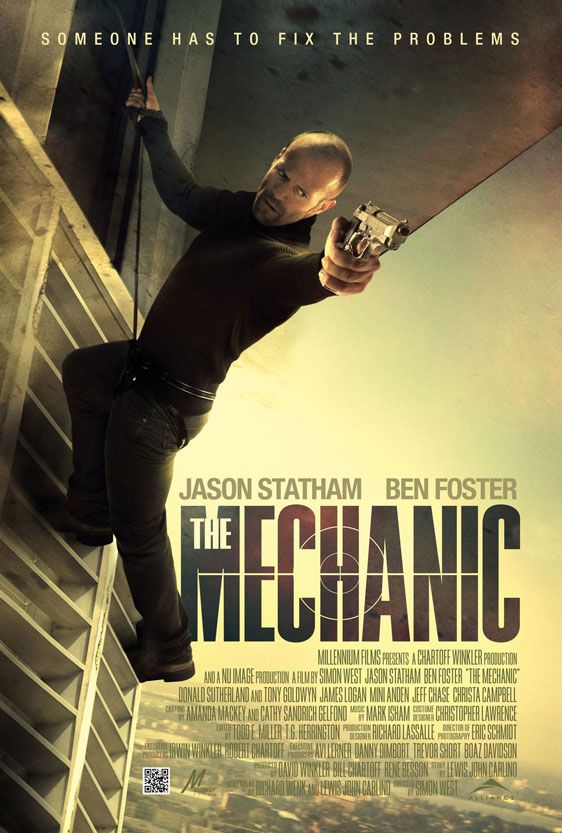 THE
MECHANIC – remade from the 1972 Charles Bronson film of the
same name, unseen by me – is about a hitman that lives by his own
obsessive rules, code of conduct, and need for anonymity that never really
has anything tangibly new to say about the nature of professional contract
killers that we have not all seen before in countless past
action-thrillers. The film
contains the obligatory calm, cool, introverted, and lethally dangerous
hitman that is the best at what he does at his job, but he slowly begins
to have second thoughts about his employers and their choice of targets.
As a result, he decides to take matters into his own hands and
plots a retaliatory mission so that he can finally break free from his
bosses once and for all.
THE
MECHANIC – remade from the 1972 Charles Bronson film of the
same name, unseen by me – is about a hitman that lives by his own
obsessive rules, code of conduct, and need for anonymity that never really
has anything tangibly new to say about the nature of professional contract
killers that we have not all seen before in countless past
action-thrillers. The film
contains the obligatory calm, cool, introverted, and lethally dangerous
hitman that is the best at what he does at his job, but he slowly begins
to have second thoughts about his employers and their choice of targets.
As a result, he decides to take matters into his own hands and
plots a retaliatory mission so that he can finally break free from his
bosses once and for all.
Does
any of this sound remotely familiar?
It certainly did for me, and this newly retooled MECHANIC is
definitely not dull to watch, nor is it an action thriller that’s not
proficiently made, but its real problem is that it never really engaged me
in its characters or their dilemmas.
The film does throw in an added dimension to the hitman’s life in
the form of a very unlikely choice of protégée that he finds himself
training to be his sidekick, but the mentor/trainee arc to the film is
also quite feebly developed.
Beyond
the character dynamics and relationships, there is no real figure that
commands – nor deserves – our rooting interest.
These men are impenetrable as likeable protagonists: the main
character indiscriminately kills people without remorse (at one point, a
cripple in a wheelchair) and is so withdrawn and sullen that you have to
remind yourself that this is the “hero”.
The manner that THE MECHANIC goes out of its way – especially
near the final act – to emphasize that this man is indeed the
hero is kind of manipulatively contrived and false.
Compared to, say, THE AMERICAN,
which also featured a dexterous, resilient, and merciless killer-for-hire,
THE MECHANIC plays itself safely as commercialized and sensationalist pap.
Arthur
Bishop (Jason Statham) is an assassin that works for the mysterious “Company”
that often requires high profile targets to be taken out quietly while
making it appear like accidents (one of the central weaknesses of the film
is that it’s hazy as to what the “Company” really is and what they
represent). Bishop is not a
simplistic killer that uses typical means to inflict death; rather, he
engages in complex and fiendishly organized scenarios that manage to rid
the world of his targets while never once pinpointing any suspicion on him
as the culprit. He is
meticulous in his research and level of obsessive preparation and after he completes one significant mission (in the
film’s fairly rousing opening sequence) he is given a new one by a
top ranking Company official (played well by Tony Goldwyn) that is as
personal as it gets: he wants Bishop to murder his own mentor, Harry
McKenna (Donald Sutherland, uniformly decent in a small, throwaway cameo
role) that apparently has been engaging in some dicey Company deals
outside of work.
One
of the film’s great and ingenious scenes involves Bishop’s convoluted
plan (which I will not reveal) to lure Harry out of his office and into an
area that he feels is safe and secure…. which is an ideal place for
Bishop to quietly murder his former teacher.
Even though he has a moral conflict with the task at hand, Bishop
nonetheless completes it with an icy resolve…and some melancholic
regrets and feelings of guilt. His
guilt gets to him so much that he decides to atone for his sin by taking
in Harry’s troubled, black sheep son, Steve (Ben Foster) and decides to
train him as his father did him. Of
course, Steve has no idea that Bishop was his father’s killer, but he is
stern with his desire to find his dad’s murderer and exact some revenge,
which makes Bishop’s mentor relationship with him that much more
intricate and potentially hazardous.
Things get ever more arduous for the pair when the Company begins
to have issues with Bishop’s non-sanctioned training of Steve, not to
mention that Steve’s first mission nearly ends in disaster.
I
liked the pairing of Statham and Foster in the film. Statham in
particular has become one of the most dependably cool, elegantly rugged,
and understatedly suave action stars of his generation.
There is not much in the way of a character with much depth or
back-story for him to play in Bishop, but the actor brings his low-key
charisma, his piercing glare, and his fist clenched tenacity that makes
him so enjoyable to watch in these types of films.
Foster is a young actor that has had a field day playing intense
loose cannon roles with a fidgety anxiety and a pent up hostility and edge
that can boil over at any moment, which makes him very reliably cast as
Steve. He evokes an irritated
impetuousness that makes for an effective foil to the by-the-books and
rigidly prepared Bishop who demands perfection in implementing
all of his missions.
THE
MECHANIC was directed by Simon West, a British filmmaker that many may
remember helming 1997’s CON AIR, a fairly brainless, but undeniably
effective and viscerally exciting action picture.
West certainly is a capable director when it comes to making films
with wanton destruction and unapologetic mayhem, and THE MECHANIC
certainly coasts on its allure of being a well oiled, testosterone-laced
action bonanza that’s not afraid to pile up the bodies and show the
blood and gore really fly.
Yet,
I guess that one problem I had with the film was how West – like far too
many modern action directors – forgets to impart a sense of clarity in
some of the action scenes themselves.
When the film is not being aggressively hectic and frenetic with
the camera work, it often is an editorial nightmare when it comes to
delineating the basic geography of scenes.
Sometimes, it’s thorny to distinguish the spatial relationships
between characters, the vehicles they're driving, and their proximity
because West assaults us with action choreography that is more ocular
unfriendly than inviting and immersive.
How many bloody times am I going to have to ask this question:
when will directors keep the damn camera still and not edit with seizure-inducing cutting? There
are other better ways to suggest the chaos and intensity of moments in a
film without shaking the camera incessantly and editing shots so rapidly
that you feel like you’re watching subliminal imagery.
Also,
there are other issues with THE MECHANIC, like some gapping logical plot
holes that are kind of hard not to notice.
Like, for instance, how Bishop takes a societal fringe figure like
Steve and manages to turn him into an exemplary and efficient killer
machine virtually overnight (or, in the film’s case, during about five
or six minutes of screen time). Also, the villains of the film – The Company – are so
sketchily developed and have motives that are never really understood that
I found myself asking more questions about them than I would have if they
were a part of a
finer crafted screenplay. They
are narrowly defined merely by the constraints of the screenplay: they
are the bad guys, and that’s about it.
There is also a very minor subplot detail about how Bishop likes
listening to vinyl and really likes working on restoring his classic car
and you know – you just know – that his beloved and shiny
crimson auto will not make it out of this film completely intact.
One
area that the film really squanders on is tension and thrills:
THE MECHANIC could have truly been more compelling if it tantalized
viewers more with the central teacher/student relationship contained
within. Instead of engaging in a swift and tricky narrative that
built suspense and intrigue about when and how Steve would discover the
truth about Bishop’s relationship with his dad, THE MECHANIC routinely
seems to go through the motions and only deals with it during its final
minutes that never fully resolves it in any meaningful or satisfying way.
Plus, as mentioned previously, the film does not seem to know which
character is the one to root on as the empathetic hero and the way it sort
of makes the choice for us by the time the end credits roll by is the most
artificial and mechanical element of THE MECHANIC.
The resulting film is one that’s well acted and semi-enjoyable
as an unpretentious B-grade exploitation picture with enough hectic and
gratuitous action to keep people interested for 90 minutes, but there is
most assuredly a more uniquely compelling film to made of its spare parts
than what’s on display here.
