

 A
film review by Craig
J. Koban November
15,
2014
A
film review by Craig
J. Koban November
15,
2014
THE ZERO THEOREM 
Christoph Waltz as Qohen Leth / David Thewlis as Joby / Mélanie Thierry as Bainsley / Lucas Hedges as Bob / Matt Damon as Management / Ben Whishaw as Doctor 3 / Tilda Swinton as Dr. Shrink-Rom / Rupert Friend as TV Presenter / Peter Stormare as Doctor 2
Directed by Terry Gilliam / Written by Pat Rushin
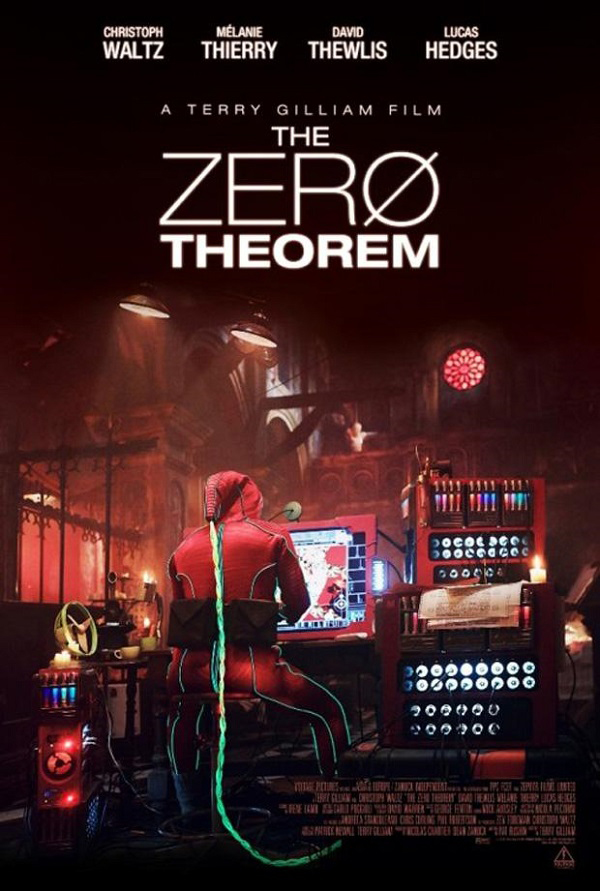 Terry
Gilliam’s THE ZERO THEOREM is a film of sublimely offbeat visual hubris
that only he can muster, but as an example of contemplative and
involving science fiction...his film leaves a lot to be desired.
Terry
Gilliam’s THE ZERO THEOREM is a film of sublimely offbeat visual hubris
that only he can muster, but as an example of contemplative and
involving science fiction...his film leaves a lot to be desired.
His first
attempt at the genre since 1996’s TWELVE MONKEYS (and a pseudo third
chapter in his dystopian sci-fi trifecta that includes that film and
1985’s BRAZIL before it), THE ZERO THEOREM seems more like an exercise
in esoteric style that showcases its director spinning his artistic
wheels a bit more leisurely than he should.
That, and there’s certainly no thematic ground that this film
covers, per se, that Gilliam has not already explored to better effect in
BRAZIL and TWELVE MONKEYS, which gives THE ZERO THEOREM an unsatisfying
aftertaste of nagging déjà vu.
Gilliam does succeed, though, in establishing a sensation of colorfully macabre disorder that’s lovingly envisioned, not to mention that he cast two-time Oscar winner Christoph Waltz in the lead role, who seems equally game at fully embracing THE ZERO THEOREM’s unbridled weirdness. He stars as the oddly named Qohen Leth, a computer programmer that has a peculiar knack for referring to himself in a plural form. Set in the distant unspecified future, Qohen works a slavish and self-loathing job “crunching entities” for a vast corporation known as Mancom, which is headed up by “Management” (Matt Damon, replete with an oddball wig and, sadly, not much of a character of substance to play with), someone that Qohen desperately wants to hook up with. Like many Gilliam characters of old, Qohen suffers from a nagging crisis of conscience and wishes for something better in his life. He waits…and waits…and waits… for an enigmatic phone call that he believes will allow him to attain self-actualization…but it never seems to come.
|
|
Qohen's
psycho evaluation, however, shows him to be relatively well adjusted, but
he nevertheless goes through therapy sessions with an AI therapist named
Dr. Shrink-ROM (amusingly played by Tilda Swinton).
While dealing with his therapy sessions and the soul-crushing
meaninglessness of his daily work grind, Qohen does have a chance meeting
with “Management” and begs that he work full time at home…mostly in
hopes that he will not miss that fateful phone call that’s been yearning
for. Even though Management
believes Qohen to be nuttier than a proverbial fruitcake, he does grant
Qohen his wish, but the more time he spends in isolation at home waiting
for his call – while trying to crack the “Zero Theorem”, which would
unravel the hidden mysteries of life – the more Qohen breaks from
reality in largely unhealthy ways.
Screenwriter
Pat Rushin seems inspired by works as far ranging as WAITING FOR
GODOT and Gilliam’s own BRAZIL in his exploration of a man driven to
near madness in trying to find meaning in a chaotic futuristic world that
subverts individuality. Gilliam’s
overall aesthetic sensibilities lends itself well to Rushin’s story and
themes, and the director predictably has a field day in conjuring up this
bleak, nihilistic, yet paradoxically neon-colored world of the future.
The rich and engaging production design and visual effects – done
on a remarkably small budget – are all consummately on point.
Gilliam has ample fun in an early scene, for example, that has
Qohen sheepishly try to make his way through the densely populated city
streets while omnipresent video billboards and a constant barrage of
commercial ads bombard him at every waking moment.
The future of THE ZERO THEOREM is like a perverse nightmare of
consumerism run amok; this film simply looks sensational.
The
performances, as stated, are crucial to nailing the film’s tone of
sickening anxiety and uneasiness. Waltz – bald as a baby and with a wide-eyed lucidity –
has the look of a man that hasn’t slept in weeks and his performance as
Qohen walks a slippery sloop between ludicrous madness and internalized
pathos. Alas, he acclimatizes
himself well to the proceedings, as does Swinton, who proves here (just as
she did earlier in the year in SNOWPIERCER)
that she can play bizarrely flamboyant and amusingly sinister characters
in her relative sleep. David
Thewlis shows up as well in a decent supporting role-playing Joby,
Qohen’s supervisor, as does the luminous Melanie Thierry in the integral
role of Bainsley, a figure that appears in Qohen’s life in multiple
planes of reality.
Yet,
for as rich as the film looks on a visual level and for as solid as the
performers are here, I struggled with THE ZERO THEOREM throughout to find
a reason to actually care about any of these characters and their
respective dilemmas. Most of
the characters themselves are kind of abstract and vaguely defined
entities within the story, some coming and going when they please, whereas
some (like Damon’s would-be significant antagonist) being introduced as potentially weighty
personas and then are all but ignored later on.
THE ZERO THEOREM emerges as a potentially enthralling tale of
Qohen’s existentialist grief and pain, yet it’s so bloody hard to
identify with him as a relatable character worthy of our rooting interest.
When a film is populated by a "hero" that’s so
exasperatingly idiosyncratic it becomes really, really difficult to
actually give a damn about his journey in the film.
Gilliam does achieve a few moments of strange fascination in the film, especially when Qohen decides to abandon his actual world and descend into the virtual one of the Internet; he dons a foppish red and green elf-like body suit that connects his mind directly online, which often results in some of the film’s more enticingly hallucinatory sequences (a recurring motif of a virtual-fantasy set on a lush and tropical beach is a surreal trip that Gilliam takes great delight in). Yet, all of the film’s manically imaginative flights of visual fantasy simply can’t make up for the screenplay’s lack of a narrative and dramatic follow-through. When it boils right down to it, the thought-provoking ideas and themes presented within THE ZERO THEOREM are reduced down to half-baked conceits that never pay off as handsomely as they should have. Terry Gilliam has unequivocally proved with his past films that he can make disturbing and bleakly funny dystopian sci-fi satires with the best of them, but after watching THE ZERO THEOREM it’s abundantly clear that he’s simply just lazily recycling his own material.
It’s just time for him to make a different kind of movie. He’s certainly capable.
