

 A
film review by Craig
J. Koban January
12,
2015
A
film review by Craig
J. Koban January
12,
2015
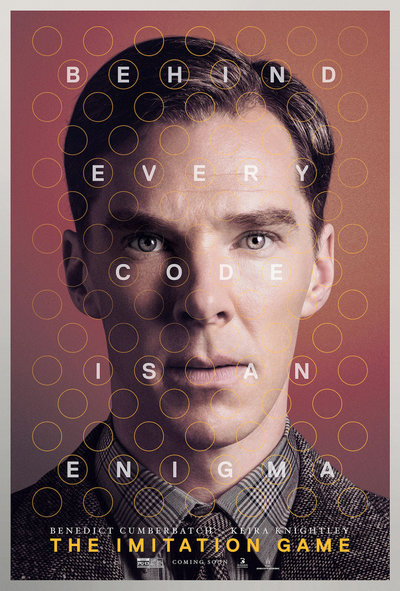
THE IMITATION GAME 
Benedict Cumberbatch as Alan Turing / Keira Knightley as Joan Clarke / Mark Strong as Stewart Menzies / Matthew Goode as Hugh Alexander / Rory Kinnear as Nock / Charles Dance as Commander Denniston / Allen Leech as John Cairncross / Matthew Beard as Peter Hilton
Directed by Morten Tyldum / Written by Graham Moore
 THE
IMITATION GAME is a different type of war genre film in the sense that
it’s not about enlisted men serving and dying on the battlefront, but
rather about intelligence agents behind closed doors that used their
cunning wits to help win WWII in secret.
It was these scientists and engineers that fought a different type
of war that didn’t make it to the newspapers; their clandestine efforts,
largely unknown until they were declassified five decades later, changed
the whole makeup and outcome of WWII.
They were really unknown soldiers.
THE
IMITATION GAME is a different type of war genre film in the sense that
it’s not about enlisted men serving and dying on the battlefront, but
rather about intelligence agents behind closed doors that used their
cunning wits to help win WWII in secret.
It was these scientists and engineers that fought a different type
of war that didn’t make it to the newspapers; their clandestine efforts,
largely unknown until they were declassified five decades later, changed
the whole makeup and outcome of WWII.
They were really unknown soldiers.
One
in particular was Alan Turing, whose immensely significant contributions
to Britain’s intelligence efforts in the war cannot be underestimated.
He was also, rather regrettably, a deeply tragic figure whose life story
beyond the war effort was heartbreakingly sad.
An unqualified genius, Turing created a theoretical computing
machine (a far cry before anyone was even contemplating the very concept
of “thinking machines” or computers) that was instrumental in helping
the allies break Nazi Germany’s impenetrable Enigma Code, which helped
in cracking encoded message and enabled the Allies to secure a victory in
WWII. Often considered the
father of computers, Turing’s electromechanical machine (the size of a
large room, but essentially a first-gen computer) is said to have
shortened the war in Europe by several years, thereby saving countless
lives in the process. This
man was a hero.
Yet, this “hero” was also a closeted homosexual at a time in the UK when homosexuality was still criminalized. Despite Turing’s incalculable assistance to the war effort, his sexual orientation became public knowledge. He was prosecuted in 1952 and instead of serving prison time he opted for the alternative punishment imposed by the court: chemical castration.
He eventually took his own life in 1954.
|
|
THE
IMITATION GAME, being a war era film, also fights its own war within
itself. Turing was easily
one of the most significant and influential men of the 20th
Century. His story is one
that deserves to be told, and Norwegian director Morten Tyldum (whom
previously made one of the best pure thrillers of recent memory in HEADHUNTERS)
does a bravura job of relaying the significant arc of Turing’s Enigma
Code solving story. The film
captures the man’s peculiar brand of isolated brilliance (many around
him thought he was an eccentric and socially introverted crackpot), but it
was his keen intellect and invention that turned the tide of the war.
Yet, where THE IMITATION GAME really falters is in its examination
of the post-war struggles that Turing found himself dealing with that
lead to his death. The man
behind one of the most crucial contraptions of WWII
that helped win it – which acted as a
catalyst for further advancements and study in computer engineering – was shamed and destroyed by the petty
short-sightedness of society’s backwards-minded laws and norms.
The film simply doesn’t do as good of a job relaying the tragic
consequences of Turing’s hidden life as it does with showcasing his intelligence
work.
That’s
not to say that THE IMITATION GAME is not enthralling as a reality based
war film, even when it does make some odd and jarring narrative detours
with time chronology, the same issue that somewhat stymied the overall
flow of UNBROKEN,
another recent war genre film. THE IMITATION GAME spans three essential time periods of
Turing’s
(Benedict Cumberbatch) life - his
lonely, isolated, and unhappy adolescent years, his rousing success during
wartime, and then finally his horrendous post-war fall
from grace when he was convicted of gross indecency for being a
homosexual. Most of THE
IMITATION GAME’s running time is devoted to Turing’s years at
Bletchley Park, where he and a group of scientists – Hugh Alexander
(Matthew Goode), Joan Clarke (Kiera Knightley), John Cairncross (Allen
Leach), and Peter Hilton (Matthew Beard) – served under Commander
Denniston (Charles Durace) and MI6 agent Stewart Menzies (Mark Strong) in
hopes of cracking the Nazi’s code.
Of
course, like most aloof and reclusive geniuses that are smarter than any other
five geniuses in the room combined, Turing is not well liked by his
peers. His whole conception
of “Christopher” (the name he gave his thinking, code breaking
machine) was so far ahead of its time that his contemporaries all but
wrote him off as a demented intellectual fanatic.
Tyldum juxtaposes Turing’s lack of acceptance by his work
colleagues with the other story of his past boarding school life as a teen
in the 1920’s, a time when his intellect was blossoming alongside his
sexual awakening. Yet, the
key WWII era (from the late 30’s to mid-40’s) period of Turing’s
life are ostensibly presented as a flashback to the other narrative arc of
Turing in the 1950’s facing criminal prosecution.
I’ve often lament how films mechanically plot their stories
from points a to b and then predictably to c, but there’s a case to be
made that THE IMITATION GAME’s disjointed flashbacks and flashforwards
make for a muddled and confusing narrative.
The
film is owned by the hypnotically mesmerizing performance of Cumberatch as
Turing, who’s more than equal to the task of exploring the
multi-faceted and deeply complex man and mind.
Cumberbatch’s idiosyncratic performance tendencies and overall
manner of modulated vocal timbre helps frame Turning as a figure that was
deeply assured of his own abilities and intellect, but was also plagued by
insecurity and anxiety about his closeted homosexuality.
Turing was a fiery being of passion and vigor, but he was not
wholly sympathetic: he was a standoffish, deeply arrogant, and demeaning figure that looked down at the
mental inadequacies and
limitations of his allies. Cumberbatch
is the perfect performer for evoking Turing’s unique brand of
unconventional genius while showing him as a physically and socially gawky
being that was emotionally boxed in by a society that hated his sexual
predilections. The actor
simply carries every waking moment of THE IMITATION GAME.
Cumberbatch’s
empowered and towering performance, though, somewhat overwhelms and
marginalizes the rest of the cast, but THE IMITATION GAME does have a host of
solid supporting performances as well.
Charles Durance is arguably the only other actor on screen that can
share a scene with Cumberbatch and hold his own as Turing’s prickly,
narrow minded, and tough-minded commander.
Keira Knightley gives a nicely understated performance of quiet
grace that acts as an effective foil to Cumberbatch’s more theatrical
flare in the film. Joan
Clarke served as Turing’s friend, confidant, and then impromptu wife when
the circumstances of their service kind of demanded it. There’s a hint of personal tragedy to Clarke as well,
seeing as she let herself be won over by a man and gave her heart to him
when his heterosexuality was just a false façade.
The film does have a confessional scene between the pair where
Turing lays his cards on the table that frustratingly feels like the
product of cozy and convenient screenwriting.
Maybe that’s the real problem with THE IMITATION GAME: it’s one of those tailor made, Oscar nomination friendly biopics about a tormented and misunderstood brainiac that doesn’t examine his life as thoroughly as it should have. Perhaps the larger arc of Turing’s behind-closed-doors war service and his later post-war disgrace would be better suited to either a longer film or a mini-series. THE IMITATION GAME tries to cover too much ground in its 114 minutes, not to mention that it struggles with finding an equal and proper balance between being an uplifting and awe-inspiring story of Turing’s war efforts and a damning chronicle of the miserable and unseemly fate that his own country’s laws placed upon him. The machine that Turing created (arguably, I wouldn’t be writing my review of this film on my PC if it were not for him) saved his nation from more death and suffering, but the same nation caused Turing an unpardonable amount of personal grief. How absolutely cruel and ironic. THE IMITATION GAME, as a result of its overall approach to the material, feels somewhat lopsided, but its redemptive saving grace is Cumberbatch leading the charge, and he ultimately makes the film engaging despite its deficiencies.
