

 A
film review by Craig
J. Koban August
14,
2015
A
film review by Craig
J. Koban August
14,
2015
INSIDE OUT  ½
½
Amy Poehler as Joy (voice) / Mindy Kaling as Disgust (voice) / Bill Hader as Fear (voice) / Phyllis Smith as Sadness (voice) / Lewis Black as Anger (voice) / Kaitlyn Dias as Riley (voice) / Paris Van Dyke as Meg (voice) / Kyle MacLachlan as Dad (voice)
Directed by Pete Docter / Written by Doctor and Meg LeFauve
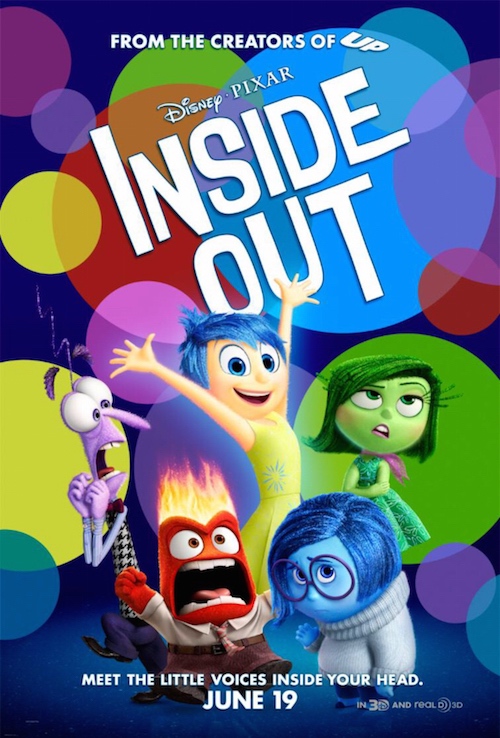 INSIDE OUT –
Pixar’s 15th feature film – is a sumptuously and gorgeously
animated, thematically ambitious, but ultimately problematic medication on
a child’s perspective on emotions and growing up.
INSIDE OUT –
Pixar’s 15th feature film – is a sumptuously and gorgeously
animated, thematically ambitious, but ultimately problematic medication on
a child’s perspective on emotions and growing up.
It’s from
director Pete Doctor, whom previously made the masterful UP, which is highly
fitting (that film focused on the nature of growing older, which makes it
a nice counterpoint/companion piece to his newest effort).
I’ve been somewhat disappointed with the recent crop of Pixar
films, filled with bloated and unnecessary sequels like CARS 2 and
MONSTERS UNIVERSITY, so I welcomed INSIDE OUT with open arms as a new
standalone feature. The iconic Bay area studio certainly deserves props for not
slavishly regurgitating company formulas with INSIDE OUT, which is
fiendishly inventive on a premise level.
Alas, my main problem with it is that it's tonally all over the
map, which negatively subverts its dramatic impact.
That, and perhaps
INSIDE OUT is a bit too clever and trippy for its own good in the sense
that it dives into the psychological processes that both children and
adults go through on a daily basis, which are concepts that
younger viewers may or may not have difficulty grasping.
There’s no doubt that Doctor and company have lovingly crafted an animated film that dares to tap into a
strong defensive theme of the
necessity of a broad emotional spectrum (from sadness to anger to fear to
happiness) as part of a normal and healthy development cycle for children
growing up into adolescence. On
these levels, INSIDE OUT is considerably more daring and risky in approach
than a handful of Pixar’s past films, seeing as very few found ways of
navigating through such complex and abstract concepts (at least as far as
animated films are concerned). In many
respects, INSIDE OUT joyously bucks the trends of many family films on a
level of its sheer complexity, but it becomes clear that the ambitiousness
of the film sometimes exceeds Doctor’s grasps and handling of the
material at times.
|
|
As for the
film’s decidedly out-there premise, the majority of INSIDE OUT takes
place…inside the brain of a young girl.
Young Riley (voiced by Kaitlyn Dias) is a relatively ordinary and
well-adjusted girl that begins to struggle with depression after her
mother (Diane Lane) and father (Kyle MacLachlan) uproot themselves from
Minnesota to San Francisco for work related reasons.
Of course, Riley tries to be chipper and a pillar of optimism for
her parents during the stressful move, but inwardly she’s struggling.
She misses her school, friends, youth hockey team, and just
about everything back home. When
the clan arrives in their less-than-impressive new San Fran dwelling –
and have to wait days before the movers arrive with their possessions –
Riley begins to emotionally implode even more.
She tries as much as she can to stay positive, but she’s finding
it progressively more difficult by the day.
Now, all of this
sounds relatively modest and straightforward as far as storytelling goes.
Yet, the other half of the film takes place, as mentioned, inside
Riley’s head, which is shown as a mission control-esque workstation
monitored by her various “moods.”
There’s the sprightly and perpetually easy-going Joy (Amy Poehler);
the blue skinned and very sad...Sadness (Phyllis Smith); the scrawny and
odd looking Fear (Bill Hader); the uptight and snobby Disgust (Mindy
Kaling); and lastly Anger (Lewis Black), a red skinned, flat-topped
cauldron of…well…anger. Riley’s
whole emotional network is monitored by these beings, whom often fight for
control over the switchboard, with none ever assuming a majority of
control. Riley’s memories
are presented as round spheres that are color-coded based on the dominant
emotion and shipped from one neural location to another in office-like
vacuum tubes. The actual
thrust of the story concerns one of Riley’s memories – an apparent
happy one for her – that inadvertently gets reclassified as sad – and
(for reasons far too complicated to explain) Sadness and Joy find
themselves expelled from the control room, leaving the incompatible duo
struggling to return and regaining a proper level of cognitive balance for
Riley.
INSIDE OUT is
reliably astounding on a level of its consummate visuals.
The sequences involving Riley on the outside, so to speak, have a
traditional level of cartoony realism that we’ve come to expect from
Pixar as of late, whereas the inside of her head opts for a more decidedly
fantastical and whimsical approach to portraying this strange and ethereal
universe. Of course, the sheer level of detail in the diverse imagery
on display here is extraordinary, highlighting the studio at the zenith of
their artistic might. There
are a couple of brilliant aesthetic moments sprinkled through the film,
such as one featuring Joy and company taking a trek through Imagination
Land, but not before taking a detour through Abstract Thought, where
literally everything is represented as a flat Cubist compositions.
There’s very little doubt that Doctor and his crackerjack team of
animators have thought through INSIDE OUT in painstaking and loving
detail. As a visual experience, the film is an absolute triumph.
Thematically,
INSIDE OUT is on solid and noble minded ground as well in its unusual
– but justified – defense of melancholy as a valid emotion that every
child should and must go through as a part of their development as human
beings. Sadness, as both a
character and emotion within the film, starts off the story as sort
of the black sheep of the control room family, often overlooked or
disregarded. As the film
progresses and Joy and Sadness’ quest to return home hits many barriers
and roadblocks along the way, it becomes clear that there is legitimacy to
Sadness as a being of necessity for Riley.
She serves just as much of a purpose as Fear, Disgust, Joy, and
Anger. Part of the narrative brilliance of the underlining story is
how the film takes incredibly thorny and intangible concepts and
represents them in a manner that’s easily decipherable and meaningful. Ultimately, I appreciated how INSIDE OUT fights for the
significance of being sad as an important development hurtle that
shouldn’t be ignored.
Here’s the
problem, though, with INSIDE OUT: The characters that populate Riley’s
noggin are a little bit too outlandish and hyperactive for their own good
to the point of being distracting personalities.
There’s also perhaps a bit too much slapstick shenanigans and
pratfalls that occur with these characters that amps up the candy colored
silliness to grating levels at times (this, no doubt, was done primarily
to appease children that frankly won’t be able to grasp the
sophistication of the material here).
INSIDE OUT also has sluggish pacing that hurts its momentum; it’s
opening act is resoundingly strong, followed by peaks and valleys of
semi-compelling material in the middle, and then culminating in a fairly
dramatic climax. Sometimes,
though, the inherent caffeinated ridiculousness of the personas in
Riley’s control room literally seems like they're from another animated
movie altogether. More
restraint with this inner space world would have been welcoming.
INSIDE OUT is definitely moving in its final moments, but the entire film failed to linger with me in ways that the greatest of the PIXAR library have (my favorites still remain UP, RATATOUILLE, and THE INCREDIBLES). At a sparse 90-plus minutes, INSIDE OUT may be the least plot-driven of all of the Pixar films, which holds it back from achieving the upper echelon of quality that I expect from its makers (the film has character development, but very little story development). Ultimately, I greatly admired INSIDE OUT for thinking outside of the box as far as contemporary animated fare is concerned and for being daring and conceptionally brilliant, but as a whole it simply doesn’t stand with or apart from the pack of the most unforgettably magical Pixar films.
