

 A
film review by Craig
J. Koban April
18,
2014
A
film review by Craig
J. Koban April
18,
2014

RANK: #23
JODOROWSKY'S DUNE  ½
½
A documentary directed by Frank Pavich
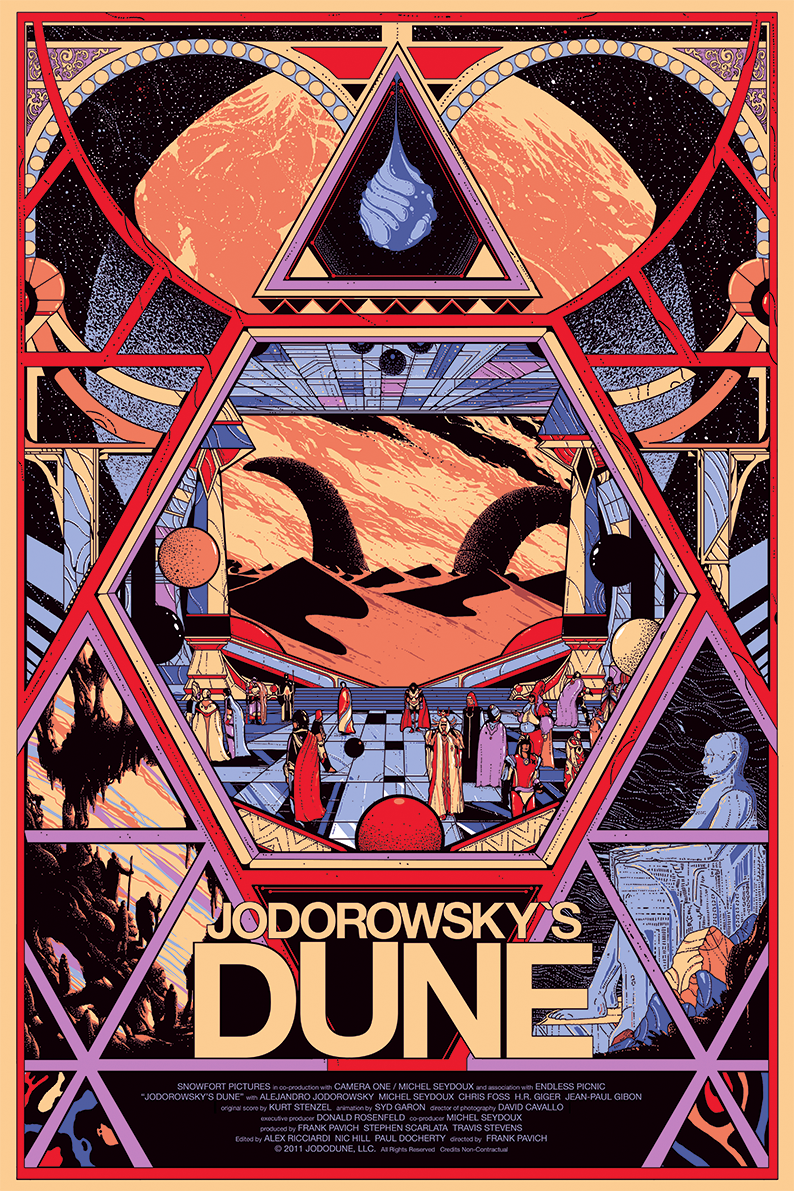 JODOROWSKY’S
DUNE is a documentary that chronicles arguably one of the greatest sci-fi
films…never made. Chilean-French filmmaker
Alejandro Jodorowsky tried, as only he could, to adapt Frank Herbert’s landmark
1965 novel DUNE to the silver screen in the 1970's, and it becomes abundantly apparent
very early on in this Frank Pavich directed documentary that this DUNE was going to be unlike any science fiction film of its
time. Jodorowsky didn’t
just want to slavishly make a studio and audience friendly escapist
blockbuster; he yearned to have his esoteric fingerprints all over it.
“I wanted to make something sacred,” he tells us during the
course of the film, “the coming of an artistic, cinematographical god.
I wanted to create a prophet.”
JODOROWSKY’S
DUNE is a documentary that chronicles arguably one of the greatest sci-fi
films…never made. Chilean-French filmmaker
Alejandro Jodorowsky tried, as only he could, to adapt Frank Herbert’s landmark
1965 novel DUNE to the silver screen in the 1970's, and it becomes abundantly apparent
very early on in this Frank Pavich directed documentary that this DUNE was going to be unlike any science fiction film of its
time. Jodorowsky didn’t
just want to slavishly make a studio and audience friendly escapist
blockbuster; he yearned to have his esoteric fingerprints all over it.
“I wanted to make something sacred,” he tells us during the
course of the film, “the coming of an artistic, cinematographical god.
I wanted to create a prophet.”
Alas,
Jodorowsky’s dream never became a reality.
JODOROWSKY’S
DUNE is so hypnotically alluring on so many levels, primarily because it
deals with a massively compelling cinematic “what if” scenario, but also because Jodorowsky – at a ripe, but still spry and
charismatic 85-years-old – makes for such a fascinating and engaging case study.
He’s perhaps best known for his deeply strange avant-guarde works
in the early 70’s, like 1970’s EL TOPO (which is largely considered
the first midnight cult film) and 1973’s HOLY MOUNTAIN, but when he was
tasked with his next project he enthusiastically pitched a bold and
ambitious concept for adapting DUNE, despite the fact that – by his own
admission – he had never read the book.
And he was deeply passionate about making it, in borderline
self-destructive ways. “If
I need to cut my arms in order to make that picture,” he boldly explains
at one point, “I will cut my arms.
I was even ready to die.” Right
from the get-go, DUNE became Jodorowsky’s obsession.
|
|
Yet, Jodorowsky's
version of DUNE
never saw the light of day, despite the tremendous outpouring of creative
energy and zeal expressed by both him and his team in wanting to make it.
How did all of this begin?
PLANET
OF THE APES producer Arthur P. Jacobs had the film rights to Herbert’s
novel in the early 70’s, but when he died the rights were optioned
relatively easily by Jodorowsky and his producing partners, mostly because
– at the time – many in Hollywood believed that DUNE was unfilmable.
From here, Jodorowsky began the massive undertaking of writing the
screenplay, which was faithful to the overall story contained within the
source material while taking rather large creative liberties with it. Jodorowsky then began the process of hiring his crew, who had
to be, by his own criteria, artistic “warriors” to see his vision
through to the silver screen. “I
was searching for the right genius in every person,” he matter-of-factly
explains, and based on his infectious enthusiasm expressed to this day in
reflecting upon the project, you gain an immediate sense that he was a
respected figurehead that lured in the people he wanted.
And what talent
he did lure in, many of which today would easily be considered a relative
dream team from a production standpoint.
Jodorowsky hired the Dan O’Bannon (who at that point directed
DARK STAR and went on to pen ALIEN) for the visual effects.
For the art department, Jodorowsky snagged French graphic artist
Jean “Moebius” Girard and Swiss surrealist H.R. Giger, the latter whom
also went on to design the now iconic look of the extraterrestrial
monsters in ALIEN. Jodorowsky wasn’t done there, further hiring Chris Foss
(then known for his exquisite sci-fi novel cover paintings) to work on
more conceptual designs for DUNE. What’s
abundantly clear is that Jodorowsky wanted the best of the best…and he
got just that. The crew here
– also interviewed via archival clips and present day anecdotes –
reflect on their own wide-eyed infatuation in seeing their director’s
version of DUNE on the big screen.
JODOROWSKY’S
DUNE is jam-packed with more sensationally juicy insights about the
production that never was, including larger-than-life tales of the
filmmaker attempting to get just the right cast for his film.
My favorite story has to be Jodorowsky convincing the then
gluttonous Orson Welles to play DUNE’s nefarious and equally rotund
villain…on a promise that the enigmatic star/director would have his
meals catered to him on set by his favorite French chef.
Then there’s the ape-shit crazy/bizarre account of how Jodorowsky
tried to hire Salvador Dali for a part, but the
Surrealist painter wanted $100,000 per hour.
Much easier was nabbing Mick Jagger (yes, that one), who agreed to
a part within seconds of being approached by Jodorowsky.
Hell, even Jodorowsky’s own son Brontis figured in on the
casting. The mid-teen was put
through a hellish six hour a day, seven days a week, two year training
regiment to prepare for his role as DUNE hero/messiah Paul Atriedes.
Jodorowsky was not above making his own flesh and blood suffer to
make his DUNE a reality.
But now to the
bigger question: How did this version of DUNE not happen?
I think it boils down to one thing: Hollywood seemed intimidated by
the robustly grandiose image of Jodorowsky himself.
Yes, there were large-scale financial issues on the table as well
(the budget ballooned to a then unheard of $15 million) and the film's length
that Jodorowsky proposed (potentially 14 hours!) clearly scared executives
as well. As a result, DUNE crashed and
burned before it was allowed to fully gestate and get off the ground.
The film rights remained dormant until the early 1980’s when, as
history has shown, director David Lynch and producer Dino De Laurentiis
swooped in and made their own 1984 version.
Arguably, one of the documentary’s most inspired and funny
moments occurs when Jodorowsky recounts finally and begrudgingly screening the Lynch
film; he felt validated by the film’s awfulness.
DUNE still lives,
though, in the hearts and minds of Jodorowsky and his crew…at least in
spirit. 3000 storyboards
exist for the film (some of which chronicle an extraordinary opening shot
that, if actually shot and pulled off, would have been one of the most ambitious
film openings ever) and innumerable costume and set design paintings.
Jodorowsky’s script, obviously enough, still exists.
The documentary approaches a level of subtle tragedy, seeing as we
will all never know just what kind of film would have emerged from Jodorowsky’s
mind and what ripple effects it
would have had on Hollywood. JODOROWSKY’S
DUNE takes a few missteps near the end in straining to make connections
between how the director's vision influenced future sci-fi films (from ALIEN
to STAR WARS to CONTACT);
some of the correlations seem valid, whereas others seem more purely
coincidental.
Still, at the heart of this addictively entertaining and involving documentary is Jodorowsky himself, whom never ceases to become an intoxicating figure of interest. He’s shown as fervently driven and more than a bit egotistical and self-aggrandizing, but also as a remarkably creative, brave, audacious, and exuberantly likeable man that truly cared about his projects, even the ones that sadly got away. The documentary ends on a note of positive hope, all things considering. Jodorowsky’s message to future generations of filmmakers is to never give up on your cinematic dreams, even when crushing defeat seems inevitable. JODOROWSKY’S DUNE is a sobering and melancholic industry tale of missed opportunity, but it’s also oddly inspirational in its outlook. It has considerable things to say not only about a lost sci-fi classic in the making, but also about the nature of how failure breeds newfound success.
