A film review by Craig J. Koban December 28, 2011
THE ADVENTURES OF TINTIN:
SECRET OF THE UNICORN  ½
½
Tintin: Jamie Bell / Capt. Haddock: Andy Serkis / Sakharine:
Daniel Craig / Thomson: Nick Frost / Thompson: Simon Pegg / Silk:
Toby Jones
Directed by Steven Spielberg / Written by Steven Moffat, Edgar
Wright and Joe Cornish, based on the comic book series “The Adventures
of Tintin” by Hergé.
| SCREENED IN |
 |
| 3D |
On paper – and to quote its
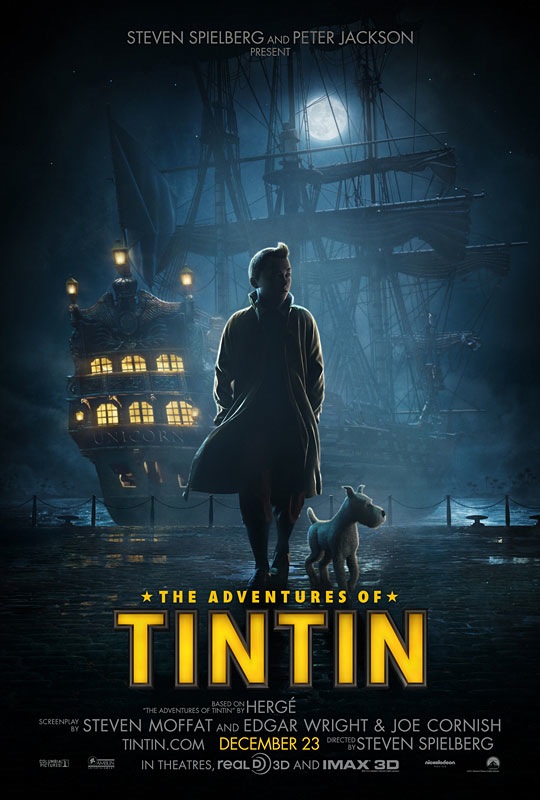
full and official title – THE ADVENTURES OF TINTIN: SECRET OF THE UNICORN
has
it all.
We have Steven Spielberg as
director, Peter Jackson as Producer, Weta Digital providing the computer
animation, John Williams lending his hands for its musical score, and,
most crucially, we have them all working together to bring Belgian artist
Georges Remi’s (under the pen name Herge) iconic European comic book to
the silver screen. Tintin may not be an institution in North America, but it was
one of the most prevalent comics in Europe of the 20th Century
since its first publication in 1929. More
than 200 million copies of Tintin comics have been sold to date.
That's kind of astounding.
To their credit, Spielberg and
company have more than faithfully captured the tone and spirit of
Herge’s original works. The
comics always traversed fluidly through a variety of different genres,
from fantasy, murder mystery, political thrillers, science fiction, and
even sea-faring swashbuckling adventures.
It’s of no surprise why Spielberg was attracted to Tintin, seeing
as the source material and film bare more than a fleeting resemblance to
his own Indiana Jones Quadrilogy. THE
ADVENTURES OF TINTIN has a perpetual level of innocent and wholesome
enthusiasm about it, not to mention that it’s in the grand tradition of
the Saturday afternoon adventure serials that inspired Spielberg in his
youth. TINTIN, much like its
graphic novel counterpart, washes itself of cynicism and evokes a
contagiously lively and light-hearted vibe throughout.
Where the film falls short,
though, is in its overall storyline and character development.
At nearly two hours – quite long for most CGI animated efforts
– there’s not much in the way of an overreaching plot to be had in
TINTIN, outside of a central mystery to be solved and the location of an
obligatory treasure to be discovered by its intrepid heroes.
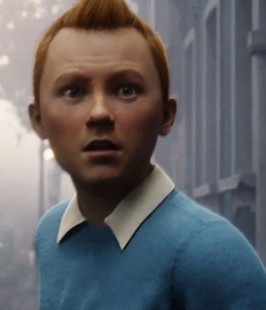
Then there’s the main protagonist himself, who’s only thinly
and enigmatically defined in the film.
Tintin has the intelligence, physical dexterity and strength of
an adult, but has the wide-eyed inquisitiveness, appearance and voice of a
young adolescent. He works as a globe-trotting journalist solving cases all
over the world and has become a legend in his field, despite, however,
looking like he’s about to make his first step into a junior high school.
This is a film character ingrained with a personality, to be sure,
but we really don’t ever learn much about him.
Nonetheless, Tintin remains a likeable and enthusiastic creation, and the film deals with his exploits to uncover a centuries-old mystery that sees him traveling to various corners of the world. Along for the ride are his never-endingly faithful – and smarter than many of the other human characters – white dog Snowy, who actually occupies many of the film’s more amusing moments. There are many instances when the people around this adorable little canine seem confused and disoriented as to what to do next, that is until Snowy puts them all to shame by wisely pointing out the way that was in front of them the whole time.
|
||||

The film has a terrific
opening: Tintin (voiced by Jamie Bell) and Snowy are touring a small
outdoor market in a European town when he becomes attracted to a model of
a three masted sailing ship, The Unicorn, and buys it.
He is then immediately confronted by a sinister man named Sakharine
(Daniel Craig) who tries to forcibly take the model away from the young
journalist, who steadfastly refuses to sell it.
After he takes the ship home, Tintin finds hidden within the model a
parchment scroll, which peaks his already insatiable curiosity
about…everything. It appears that the scroll is but one piece out
of three required to locate a lost treasure.
This allows Tintin to have a chance meeting with the nearly always
drunken Captain Haddock (Andy Serkis) who is actually one of the ancestors
of the original ship’s Captain. Unfortunately,
the pair realizes that the nefarious Sakharine has another vital piece of
the puzzle to the treasure’s location, so it becomes a race to locate
and secure the third and final clue required to find it.
TINTIN marks the very first
time that Spielberg has ever made an animated film and worked with 3D.
As for the latter, Spielberg – like Martin Scorsese did recently
with HUGO – astutely understands that utilizing three-dimensional
techniques works best for subtly conveying depth within the frame and not
assaulting viewers with visual gimmicks: it’s satisfyingly restrained
and pleasing on the eyes…and head.
As for the animation itself, Spielberg opted to use the same motion
capture techniques utilized in films as far ranging as THE
POLAR EXPRESS and AVATAR to
capture Herge’s comic universe. The
level of clarity, minute detail, and overall craftsmanship on display here
is extraordinary: THE ADVENTURES OF TINTIN is, quite simply, one of the
most sumptuously realized and executed CGI motion-captured animated films
ever.
|
|
Here’s my problem, though,
with the film’s grandiose and exquisitely rendered artifice: Herge’s
comics simply employed what is known as “ligne claire”, or a clean
line approach to the drawings with little, if any, shading.
The Tintin comics were purposely minimalist, which gave them their
inherent charm. Spielberg’s
21st Century computer rendered upgrade of Herge’s creations
captures the cartoony essence of all of the characters (they’re
exaggerated in terms of proportions, but rendered with palpably realistic textures),
aside from Tintin, as he looks more or less like a real human.
Yet, what Spielberg et al fail
to grasp here, I think, is that the microscopic level of crispness and
depth in the film’s animation almost seems disingenuous to Herge’s
original artistic aims. Tintin
was a two-dimensionally envisioned hero that almost seems out of place in
this film’s three-dimensional world.
I’ve seen some of the original animation from the TINTIN TV
cartoon, which despite being vastly more rudimentary and crude than what’s
presented here in the film, has almost more expressivity.
Just consider the film’s joyously animated opening title card
sequence, which employs bits of the film’s storyline presented in
Herge’s quaint and retro-animation style (and accompanied by the
spontaneously jazzy and colorful musical cords by John Williams).
Just image if the rest of the film followed that aesthetic.
See what I mean?
Yes, THE ADVENTURES OF TINTIN
has astounding visual flourishes that will stick with me: the film is
a masterpiece of technical craft and innovation.
The voice actors are uniformly well assembled too: Jamie Bell
captures Tintin’s eager gumption rather well; Daniel Craig is almost
unrecognizable as his dastardly villain; ditto for Andy Serkis as the
rarely clear-headed Haddock; and Simon Pegg and Nick Frost have a field
day portraying Thompson and Thompson, two Interpol agents that are
spectacularly stupid and clumsy. How
they secured jobs at Interpol is beyond me.
As for Snowy? Well…he steals most of the film from the other human
personas.
Yet, I guess that I just
wished that Spielberg was more invested in the story and characters and less
on spectacle and mayhem. There
are times when he seems too preoccupied with providing one large scale,
booming, and ostentatious action sequence after another that revels in
exhaustive showmanship first and tension and intrigue a distant second.
Look, for instance, at an elaborately staged motorcycle chase through
the streets of a Moroccan city, done largely with unbroken shots. The craft here is impeccable, to be sure, but where is the
excitement and tension? Too
many sequences like this one in the film are not so much rousing and
inspired as they are anaesthetizing on the audience.
I left TINTIN feeling bombarded, but not thoroughly entertained: the
screen just seems too jammed with busy action and not much more at times.
