A film review by Craig J. Koban December 14, 2009
JULIE & JULIA ½
½
Meryl Streep: Julia Child / Amy Adams: Julie Powell / Stanley Tucci: Paul Child / Chris Messina: Eric Powell / Linda Emond: Simone Beck
Written and directed by Nora Ephron, based on the books "Julie & Julia" by Julie Powell and "My Life in France" by Julia Child with Alex Prud'homme.
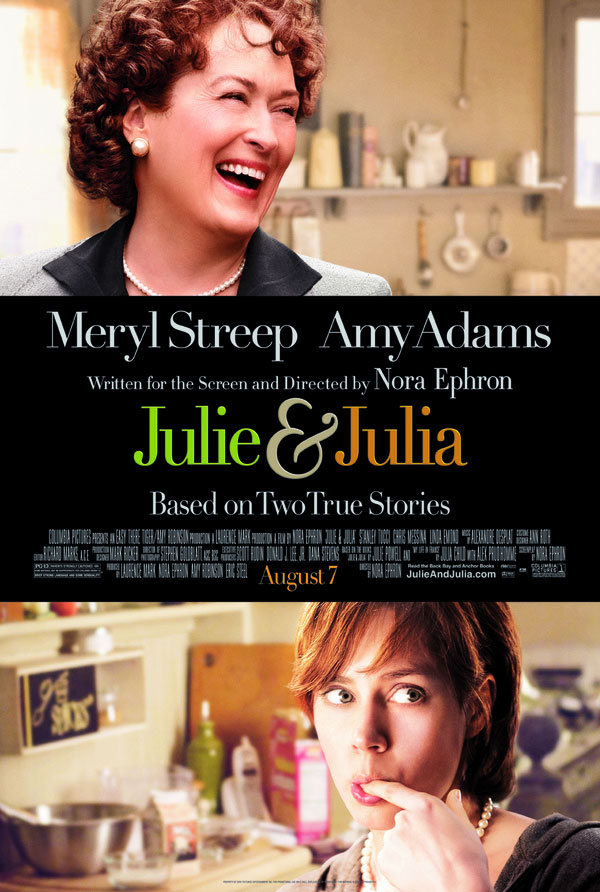 JULIE
& JULIA is a real movie first: it’s a two-for-the-price-of-one
biopic. The comedy/drama –
courtesy of three-time Oscar nominee Nora Ephron, marking her first
film since the disappointing BEWITCHED
in 2005 – is one that depicts two different people (one
famous, and the other not so much) during two different integral periods
of their respective lives. One
story focuses on Julia Child - before she became a culinary
icon – as she struggled to see her book, MASTERING THE ART OF
FRENCH COOKING, get published, which turned into an up and down ordeal
that lasted nearly a decade. The
other story concerns the more modern day Julie Powell, a lowly, post-9/11
cubicle worker in The Big Apple that aspires to make every recipe in
Child’s book, all 524 of them in 365 days.
JULIE
& JULIA is a real movie first: it’s a two-for-the-price-of-one
biopic. The comedy/drama –
courtesy of three-time Oscar nominee Nora Ephron, marking her first
film since the disappointing BEWITCHED
in 2005 – is one that depicts two different people (one
famous, and the other not so much) during two different integral periods
of their respective lives. One
story focuses on Julia Child - before she became a culinary
icon – as she struggled to see her book, MASTERING THE ART OF
FRENCH COOKING, get published, which turned into an up and down ordeal
that lasted nearly a decade. The
other story concerns the more modern day Julie Powell, a lowly, post-9/11
cubicle worker in The Big Apple that aspires to make every recipe in
Child’s book, all 524 of them in 365 days.
As novel as the central idea of the film is – which draws its inspiration from two books, Powell’s JULIE & JULIA and Julia Child’s and Alex Prud’homme’s MY LIFE IN FRANCE – Ephron’s effort here ultimately suffers from one nagging shortcoming: There is just no way that Powell’s tale is as compelling and interesting as that of Child, not to mention that having the central narrative of the film bobbing and weaving between both of their lives leaves a lot to be desired.
More
often than not, the film struggles to find parallels between the two
women separated by time and culture, and the results feel somewhat
artificial. Child lived in a
vastly more chauvinistic period where women were laughed out of French
culinary schools largely populated by men, and her lofty aspirations and ultimate
accomplishments bare much more significance and importance in hindsight.
This woman became a chef, author, and TV personality that did the
impossible of making French cuisine and cooking techniques readily
understandable and achievable for mainstream North Americans.
Powell, on the other hand, lives in a more progressive age for
women and her, for lack of a better word, stunt (which she discussed daily in her
Internet blog) was just that:
an obsessive-minded, attention-seeking experiment
simple that paled in comparison to the far-reaching ramifications of Child’s
work and legacy. Child’s
ordeal of writing and publishing her book seems so much more compelling
and intriguing, and her legacy casts a large, looming shadow over
Powell’s fairly trivial efforts; the resulting film rings a bit falsely when it tries
to
correlate their struggles.
The
film has two beginnings: The first would be set in Paris in 1949 when
Child (Meryl Streep) is shown as a younger woman that has grown to love
the culture and refinement of all things France.
Especially
the food! Her
husband, Paul (Stanley Tucci) has been stationed in Paris by the OSS and
during an early scene where the pair share and tangy and tasty sole meunière
she simply cannot believe how exquisite tasting it is.
Julia herself, a former OSS clerk, struggles somewhat as to what to
do with her life while her husband works, and she inevitably and fatefully
decides to tackle cooking. She manages to talk her way into the Cordon Blue cooking
school, which is full of male chefs (she is in fairly uncharted territory
here), but she slowly begins to develop a heartfelt passion for cooking, so much so that she decides, with the assistance of some other
female colleagues, to write a book that would introduce Americans to
French cooking in a manner that no other book had to that point.
Child's goal was not an easy one: it would take her nearly ten years,
often fraught with many false starts, obstacles, and several obstinate
publishers before the book saw the light of day in 1963 and thrust her into the
cultural lexicon.
The
other, less captivating storyline begins in 2002 and chronicles Powell’s
mundane, claustrophobic, and fairly hellish daily life of working at the
Lower Manhattan Development Corporation that deals with the victims of the
9/11 terrorists attacks as well as those calling to complain about the
controversial plans for rebuilding the Twin Towers.
In short: Worst. Job.
Ever. Not only does
she struggle to find meaning in her work (she was once an aspiring writer,
which faltered), she also has difficulty with a recent new move to a
larger apartment with her husband (Chris Messina) that sits overtop of a
Pizzeria in Queens. Her life
sucks.
|
|

In
order to revitalize herself, Powell finds inspiration in Julia Child's
landmark 1963 book, and she then decides to engage in a year-long stunt to
cook her way through all of the recipes (and I mean all) in 365 days, which
she frankly discusses daily on her Internet Blog site.
Initially, Powell embraces her self-imposed challenge with a real
gusto and vigilant optimism, which is seconded by her husband because,
let’s face it, the man gets fine French cuisine meals everyday all year.
However, when the daily grind – as well as some difficult-to-prepare meals involving boiling live lobsters and boning
ducks –
starts to wear on her, Powell becomes somewhat delusion, compulsive, and
anti-social, which has predictable side-effects on her marriage to her
ridiculously nurturing and understand spouse.
At first he likes and supports her experiment, but the more he sees her
becoming more introverted and preoccupied each day with finishing her
quest, the more he begins to resent her for it.
If
there is one uplifting aspect about this problem-plagued film then I would
have to say that it has one toweringly impressive performance and one
outright thankless one. Streep
herself may seem like the least plausible choice to play Child (she is a
mere 5’6” whereas the real Child was mammoth at 6’2”), Ephron does
makes some bravura use of unique set decorations, forced perspective camera
angles, and wardrobe choices to suggest a larger than life woman.
Filmmaking sleight of hand tricks aside, Streep never once makes you think
that you are not watching Child on screen: Much like she did in THE
DEVIL WEARS PRADA, the actress is able to elevate mediocre
material with the power and vitality of her spectacularly assured and
poised performance. She’s
got everything about the culinary artist down cold, from her distinctive
vocal intonations, from her lumbering physicality, and, most crucially,
she encapsulates this woman’s plucky and never-ending passion and
eagerness to let everyone in the world know how important and delightful
food is. What’s key her is
that Streep does not go for a one-note imitation worthy of an SNL skit
(Dan Akroyd already did that to side-splitting effect in the 1970's, which
is referenced in the film),
but rather she captures a multi-faceted woman: one that was a fiercely
feminist spirit with an iron will and determination on the inside while on
the outside she was an amiable and deliciously joyous figure.
Streep, no doubt, will receive another Oscar nomination for her
work here.
Amy
Adams – whom I would watch for two hours in a film reciting names from
the phone book – has a thornier task of making Julie Powell feel more
flesh and blood and complicated than the script otherwise makes her.
Adams has always been a performer that brings an uncanny sincerity
to all of her roles: even in dicey films, she always elevates her
character beyond conventions and story clichés because she always comes
off as so genuine and heartfelt. On paper, Powell is kind of self-absorbed, but
Adams has a unique manner of eliciting this woman’s unwavering fanatical
drive to honor her muse’s teachings while also showing her as a woman
that grows to enjoy the many tangible pleasures of cooking.
Adams is rock solid in a largely miswritten role.
And
that leads me back into my central problem with JULIE & JULIA: There
is just too many stressed instances where Ephron tries to tries to elevate
Powell’s struggles to the same noteworthy echelon as Child's, which seems
foolhardy. Too often I felt
that the film was trying to inflate and overstate Powell’s inconsequential
accomplishment with that of Child’s.
The back and forth structure of the film – which traverse between
Child’s life and Powell’s – does not help either, mostly because its
clumsily handled and eventually comes off as distracting, especially when
it’s clear that the script strains to find correlations between the
two. Then there is also an
element in the film that is dealt with and then utterly forgotten about:
it is revealed at one point that Child (whom is pushing 90-years-old in
Powell’s time) is not entirely impressed with her work being
marginalized in a blog-inspired stunt.
This arc seems totally compelling, especially when Powell is a
person that is totally enraptured with all things Child. Even though the film never offers up a manufactured scene
where the two meet in the present, the script regrettably gets really lazy
for how it does not resolve this dilemma.
In the end, Powell still reveals her undying love for
Child…but wouldn’t she harbor more conflicting feelings, seeing as
she thinks that Child “hates” her experiment?
JULIE & JULIA also has a couple of other regrettable issues, one of which is a tacked-on subplot involving the great comic dynamo Jane Lynch appearing as Child’s even larger sister (Lynch has left me in stitches in films before, but here she is completely underused here). The other issue would be the cliché-riddled sub-plot involving Powell’s husband, which hits many predictable beats (first he likes her experiment, then detests it, then leaves her, then reconsiders his choice, and then…well…. fill in the blanks). I also did not like how the two respective husbands (played by Tucci and Messina) lack dimensionality as distinct characters: they are just another set in a regrettably long list of emasculated husband archetypes stuck in chick flicks – caring, empathetic, and endlessly nurturing, and never intolerant of their wives’ wishes. Yet, if you want to see Streep and Adams at their exuberant and cheerfully best (a far cry from their searing and solemn work in last year’s DOUBT), then JULIE & JULIA will prove to be the ultimate comfort food. Beyond that, I just felt that this somewhat novel, noble minded, and ambitious dual-biopic was a bit too half-baked for me to give it a positive recommendation.
