A film review by Craig J. Koban

Rank: #23
JCVD
 ½
½
JCVD: Jean-Claude
Van Damme / Lt. Smith: Herve Sogne / Bruges: Francois Damiens / Perthier:
Norbert Rutili / Doctor Olivier: Bisback / Vigile: Karim Belkhadra
Directed by Mabrouk El Mechri / Written by Frederic Benudis, Mechri and
Christophe Turpin.
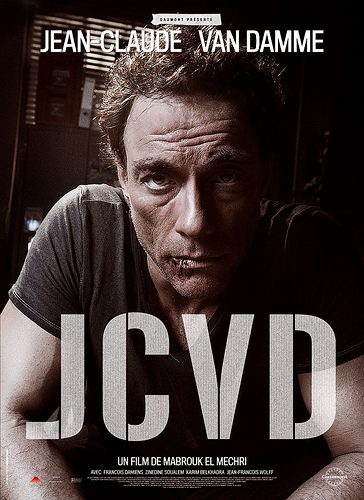 JVCD
approaches near brilliance in one crucial scene that occurs late in the
film.
JVCD
approaches near brilliance in one crucial scene that occurs late in the
film.
In one, long, unbroken six-minute take we see Jean-Claude Van Damme, playing a version of himself, give a monologue to the audience that approaches melancholic sorrow and desperation. Teary eyed, and very rarely breaking the cinematic fourth wall with the audience viewing this moment, Van Damme gives us a devastatingly frank and frequently moving confessional about what it’s like to be poor, become an overnight celebrity, accumulate wealth and prosperity, and how all of this came crashing down in a wave of drug addiction via a damning media culture in Hollywood that likes to both cheer on its self-made heroes while subsequently spitting them out when they become less appetizing. Seeing the “Muscles from Brussels” struggle to fight back his emotions reveals his inner pain and pathos.
Rarely has an action hero been so refreshingly self-effacing and
vulnerable in a film.
That’s
the hook to JCVD, which stands for, you may have guessed, Jean-Claude Van
Damme: It marks one of the
first true deconstructivist action films for the way it both celebrates
the hero in front of the camera while showing him at his most meager and
weak behind it. At face value, the film
is a basic action flick that maintains a healthy semblance of the most
common attributes of classic examples of the genre (we have a hero, a
series of villains, a series of standoffs and confrontations between the
two, etc.). Yet, what makes
JCVD so much more compelling as an experience is the way it aims its
crosshairs at the mythology of the action hero and the films they have
populated over the last few decades.
These personas have always been largely – and narrowly – shown
as muscle bound supermen that were absolutely impervious to all forms of
normal human punishment. Van
Damme, in many of his previous films, was no exception.
However, in JCVD he utterly strips away layers of his past
macho, gravity defying, and intensely macho characters and instead reveals
a very human man with filled with self-doubt and loathing about not only
his own image as an action icon, but also the industry as a whole that
made him who he is today. This
is all provided in an absolutely vanity free performance that’s both
disarmingly self-deprecating and shows an emotional facility and range we
would have never expected from Van Damme.
Perhaps what makes the film all the more intriguing is just how close to home it hits for the actor. Van Damme was always an action star of potential: He started his career in the mid-80’s in a series of mindless and disposable low budget action films and then eventually graduated to become a big box office action draw. He also can take credit for bringing the critically raved John Woo to American sensibilities with 1993’s HARD TARGET and would go on to make a series of high profile action films well in the mid-90’s.
Then…things began to unravel for the actor.
He had real life marital issues, which may or may not have
attribute with a bout with cocaine addiction in the latter stages of the
decade. Eventually, his film career fizzled to the point where I can
recall laughingly looking at his face on oodles of direct-to-video fare on
store shelves.
Last I recall, he has not made a popular American film that has
seen a wide theatrical release in nearly a decade.
Because
of all of this, Van Damme comes across as the poster boy of good sports in
JCVD. The film, helmed by
French/Algerian director Mabrouk El Mechri, was originally supposed to
treat Van Damme as a cartoonish buffoon.
Fortunately, Mechri had the persistence of vision to see past other
failed drafts of the screenplay and see Van Damme as someone more
substantial than his image has let on.
By blurring both fantasy and reality, JCVD works almost kind of like
a pseudo-reality show that is an odd and offbeat hybrid of BEING JOHN
MALKOVICH, DOG DAY AFTERNOON, and MEMENTO.
Yes, it’s an action film, but it is also a very shrewd, cunning,
and oftentimes scathingly funny satiric jab and celebrity culture and the
fanatical basis by which we initially worship actors and later abandon our
appreciation of them. The
film also works wonderful by picking apart action film clichés and
formulas, right down to the obligatory final standoff between hero and
villain where, in countless other past films, we know with unavoidable
certainty that the hero will reign supreme.
In JCVD’s case, that sort of preordained plot development is not
quite so black and white, nor is the hero all that…heroic…when facing
danger.
The
film occurs in an alternate reality, I guess.
There is a Jean-Claude Van Damme in this film world that has made
all of the films that we have grown to love...in one form or another.
The beginning of the film shows us Van Damme unleashing a maelstrom
of Van Dammage on a series of faceless villains, all done in one breezy,
intense, and ingeniously choreographed single take where he kicks,
punches, stabs, and shoots himself through all forms of evil humanity. Just when it looks like this inanely long unbroken action
take will never end, one of Van Damme’s adversaries accidentally knocks
over part of what appears to be a flimsy film set.
We learn that this is not the movie but a movie within a movie.
After struggling with the ordeal of performing in a physically grueling
take that has been botched, Van Damme angrily turns to the
director (who looks barely in his twenties) and feebly cries, “You know,
it’s very difficult for me to do everything in one shot.
I’m 47-years old!”
At
this point the film considerably mellows down.
We learn that Van Damme has recently emerged as a struggling actor
that has been finding it difficult to locate any decent work; his past successes in Hollywood are all
behind him. He’s approaching being penniless, thanks to a very
expensive child custody hearing that he is shown participating in
throughout the film. After he
loses custody of her to his ex-wife, Van Damme returns to his
childhood home of Brussels (where he is still very much an iconic action
star) to start over, but he is finding that his agent is not helping him
very much. He is not sure
what is more alarming: the fact that his unscrupulous agent wants his
client to appear in low budget B-grade flops that have two-thirds of
their budget going towards his salary or the fact that Steven Seagal
is slowly taking most of the parts he was once up for.
Van Damme, tired of appearing in one cheap dud after another,
pleads with his agent to find him a good project where he would agree to
be paid scale in hopes of a budgetary increase for effects and overall
scale. His agent laughs
incredulously at him in response. In
one of the film’s funniest reveals, the agent mentions to Van Damme that
Seagal has once again taken a project that he was interested in, but only
because he agreed with the producers to cut off his infamous ponytail.
When Van Damme makes his way to Brussels he heads immediately to a local post office in hopes of receiving a very important money transfer so that he can pay his final lawyer bill and get on with his life. When he arrives the teller and guard are acting very strange. The teller in particular gives him some real head shaking news that the post office is “out of cash.” Van Damme is initially quiet spoken and patient, but when his polite and repeated attempts at asking for his money continue to get rejected, he gets frantically upset and agitated. Shockingly, he soon discovers that he is in the middle of a planned hostage situation where the perpetrators hope to walk away with the office’s loot. If things were not bad enough for the down-on-his-luck actor, the police and media show up and inadvertently think that he is the one actually committed the hostage taking himself.
As
the film unravels in MEMENTO-like fashion (it weaves in and out of
chronological order and gives us multiple perspectives of key moments),
Van Damme attempts to be a real life “hero” to the hostages by trying
to keep them safe, all while trying very hard not to get his own head
blown off. He also attempts
to be the negotiator with the actual criminals themselves, which proves to
be a much more daunting task than even he is capable of handling.
As the pressure of captivity mounts, with no resolution in sight,
JCVD cuts ways from the action to that previously mentioned game breaking
monologue by Van Damme, where he shows behaviour that’s less akin to
martial arts-skilled action heroes and more to that of a sad, beleaguered
and troubled man that is scared shitless.
JCVD
has some familiar elements of the action/hostage standoff thriller genre,
to be sure. There is the
scheming and mentally unstable villain, the good cop on the outside that
is trying to make sense of it all, and a mob-like atmosphere on the
outside of the post office that predictably emphasizes with the
villains. Yet, the irony here
is more tantalizing, especially considering that the crowds of spectators
immediately revere the culprit because they think that the culprit is Van
Damme, a movie star hero in their minds.
The manner with which JCVD goes beyond its petty action film
surface and emerges as a sobering and relevant dissection on the cult of
celebrity is to its credit. Part
of the underlining sadness to the film is that the “character” of Van
Damme in it is a man that is widely recognized for his failures and
successes and is now really in the media spotlight in ways he never wanted
as a “criminal.” One of
the real joys of the film is to see how the nearly insurmountable pressure
of the hostage ordeal and the growing belief by outsiders that he’s the
criminal and not a victim is affecting his mental state.
Van Damme here does not summersault, pile drive, and judo chop
through his adversaries to clear his name.
There is considerably more whimpering on his part then hand-to-hand
combat. In the film’s most acerbic moment, he fantasizes that he
overtakes the hostage takers in front of the police and crowds, after
which he is greeted with overwhelming cheers, not to mention a high five
from one of the Swat cops. When
we see the real version of this fantasy, Van Damme goes from a
self-delusional action hero to a pathetic victim of circumstance.
JCVD is one of the least pedestrian action films I’ve seen in terms of approach. It adheres to the more rudimentary fundamentals of the genre’s playbook while radically dumping them upside down and mercilessly attacking them. It’s overall demythologizing of the action hero milieu is one of its riskier and triumphant elements, triumphant in the sense that it’s daring and inventive and and risky in the sense that it takes a real life muscle-bound action star and radically strips him down to a normal plane of existence. JCVD is still a work of pure make-believe despite its true-life trappings, but it feels more real because of its handling of its main hero. And the way Van Damme strips away every minute morsel of his past formidable and Herculean cinematic image and distils it down to a fragile and unstable core in that amazing six-minute monologue is one of 2008’s most hauntingly intoxicating and revealing moments.
