A film review by Craig J. Koban

Rank: #20
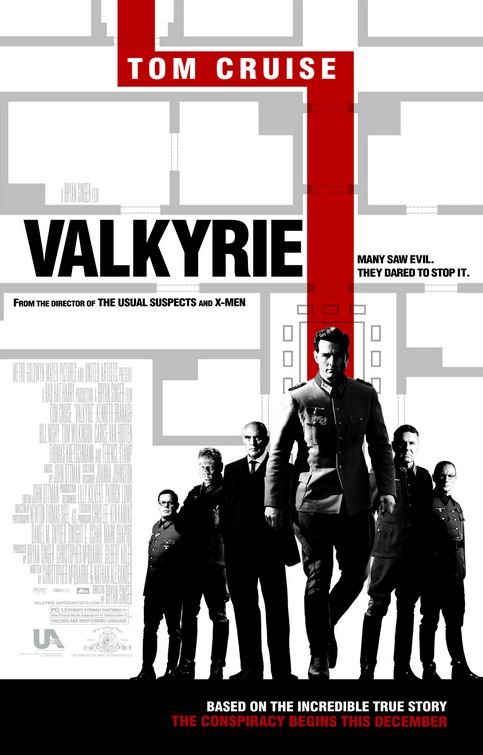
VALKYRIE
 ½
½
Von Stauffenberg: Tom Cruise / Von Tresckow: Kenneth Branagh
/ Fromm: Tom Wilkinson / Beck: Terence Stamp / Fellgiebel: Eddie
Izzard / Olbricht: Bill Nighy / Remer: Thomas Kretschmann
Directed by Bryan Singer / Written by Christopher McQuarrie and
Nathan Alexander
 On the subject of creating palpable on-screen
suspense and tension, Alfred Hitchcock once famously
remarked that, “There is no terror in a bang, only in the anticipation
of it.”
On the subject of creating palpable on-screen
suspense and tension, Alfred Hitchcock once famously
remarked that, “There is no terror in a bang, only in the anticipation
of it.”
Bryan Singer’s new
historical thriller, VALKYRIE, uses Hitch's wise words as a guiding philosophy
behind its recreation of what was the last of 15 attempts on Adolf
Hitler’s life during the tail end of WWII.
The real noteworthy accomplishment of Singer’s tightly paced and meticulously detailed
film is that it manages to
create a real sensation of dread and terror all while the overwhelming
outcome of the story - for people even vaguely familiar with history - is
well known before anyone steps into the theatre.
However, short-sighted critics that lament that VALKYRIE is
terribly anti-climatic miss what Singer is aiming for here:
Yes, it’s a reliable recreation of a real life plot within
Germany’s army to assassinate the Fuhrer – and we all know that it was
doomed to failure (Hitler committed suicide in 1945 at Fuhrerbunker near the end
of the war) – but the film is essentially a sad and frequently
moving chronicle of heroism, patriotism, and ultimately failure.
The plot in question concerns
the real life exploits of Graf von Stauffenberg, a German WWII
colonel that did indeed fight bravely for his native country: he lost his
left eye, his entire right hand, and two fingers on his left hand in a
daring surprise Allied air attack on his troops in Tunisia.
He would also emerge from the war effort emotionally tainted and
personally disgusted with the cause that Germany was fighting for.
Stauffenberg was known to be offended by the Nazi treatment of
Jewish people in the 1930’s (despite the fact that Singer’s film does
not dwell on it as much as it probably should have) and unavoidably
considered his country’s government tainted and corrupt at its core.
Eventually, he would be the daring and ultimately courageous force
behind an audacious attempted coup of Hitler’s government, which – as we all
know – was condemned to failure. The
aftermath of the painstakingly planned, but botched, mission was 700
arrests and over 200 executions, included Stauffenberg himself, alongside
most of his known accomplices (no need for a SPOILER WARNING for
historical facts, people).
VALKYRIE perhaps is one of
the only films I've seen were Nazis are humanized (granted, at least the ones that
grew to
despise what their nation has become).
Clearly, we understand and accept the fact – before the opening
credits roll by – that Hitler will emerge mostly unscathed by
Stauffenberg’s attempts on his life, but VALKYRIE is still an
infectiously provocative and intensely immersing war film because of the
way it takes viewers into the inner circles of a group of Germans that
were so fed up with their country’s leadership that they were willing to
sacrifice the oaths they took as officers – and their own lives – to
make a radical change for the better.
The really compelling facet of the film is its portrait of
Stauffenberg himself, a man that is wholeheartedly devoted to his duty as
Nazi colonel, but had the right frame of mind to understand that what the
Nazis were doing was incalculably wrong and immoral.
He recognized what was at stake, and the personal sacrifices he
made – which cost him everything - makes VALKYRIE
more of an absorbing and introspective character drama than I was
expecting.
The script (written by
Singer’s USUAL SUSPECT collaborator, Christopher McQuarrie, alongside
Nathan Alexander) is epic in scope and scale: it covers nearly two years
from early 1943 to the final and grave day of the bungled assassination
attempt on Hitler. The film,
of course, is fictionalized, but its adherence to known historical
accuracy is a real blessing, and this ultimately allows us to feel like we
are experiencing the history of the film and not just passively viewing
the proceedings to its preordained outcome.
The film also benefits from is universally solid and eclectic
casting: We initially meet
Colonel Stauffenberg (Tom Cruise, more on him later) both before and right
after he suffered his life-altering wounds in Africa while overseeing
Germany’s Ten Panzer division. Because
of his socio-political leanings against Hitler’s Germany, he becomes an
easy recruit for the clandestine resistance leader Major General Henning
von Tresckow (the great Kenneth Branagh, effectively low key and coolly
charismatic). Tresckow's
previous mission to kill Hitler was an unmitigated failure, so he and his
compatriot, General Friedrich Olbricht (the dependably decent Bill Nighy)
decide that Stauffenberg would be a good fit for their team.
All of them have no problem effectively working together, seeing as
they all foresee that the right and moral thing to do is to eliminate
Hitler and his higher ups from office to cleanse Germany and return it to
a more healthy state to find an honorable peace with the Allied forces.
The resistance also has
several other important key members that Singer patiently and observantly
introduces: We see General Ludwig Beck (Terrance Stamp, playing his part
with a fiery dignity and calm, statesman-like poise) and the resistances’ would-be
replacement for the Chancellor, Carl Goerdeler (Kevin McNally).
Problems soon arise when it is revealed that Tresckow is ordered to
be sent to the German front, which makes any more efforts on his part to
get close to Hitler all but impossible.
All the resistance leaders unanimously agree that Stauffenberg is
the most appropriate replacement as field leader of the resistance.
It should be noted that the
plan to kill Hitler was not just simply a matter of getting close to him
and executing him. Far from it. The
resistance’s plan was bold and enterprising – if not a bit crazy – but
also logical at its core: the most basic idea behind the plot was to use a key
defensive strategy employed by Hitler against him.
Hitler had a reserve force that was trained, at a moment’s
notice, to stay back and defend Berlin and its leader if the Allies ever
attacked (this strategic operation was known as “Valkyrie”).
The ingenious part of Stauffenberg’s plan was to murder Hitler during a key Nazi meeting while secretly using the reserve forces to
both stabilize Berlin after his death and to immobilize the SS.
There is one large loophole in their end game: General Freidrich
Fromm (the cunning Tom Wilkinson) is the undeniable head of the reserve
army that Stauffenberg needs to see his plans through to successful
fruition. Even worse is the
fact that he is a staunch figure when it came to organization and not
doing anything that was not in Hitler’s best interest.
The “Fromm Factor” added a near paralyzing blow to the
resistance, but through some remarkable resourcefulness and intuition, the
plan does go through, but just not with the wanted results.
Because we know that Hitler
did not die as a result of the resistance’ plot, the easy response to
VALKYRIE would be to label it as redundant storytelling.
Yet, the true richness of the film’s story is not about what
eventually happened, but rather the build up to what did regrettably
transpire. Since the outcome
is so widely known, any amount of tension and intrigue that Singer and
company could drum up would seem near unattainable.
However, those looking for more conventional action/war film
heroics and a sense of exalting victory overlook the film's themes:
VALKYRIE is a collected and shrewd examination of the players of
the conspiracy, their mind sets, and the path they took towards executing
Operation Valkyire. The film becomes more rousing and inspiring – despite its
otherwise somber and grim conclusion – because it dives into the
psychology of these personas and makes us understand the gigantic
obstacles they faced on their path to success.
The film is a stirring tribute to the men that worked for a despotic
tyrant and then decided on doing the right thing, no
matter what the burden or cost.
Nonetheless, Singer does do
an amazingly assured job of crafting tension in individual moments.
Being no stranger to large scale action set pieces (see the first two
X-MEN films and the recent epically mounted and budgeted
SUPERMAN RETURNS), Singer is right at home in the arena of raw spectacle
(the opening attack on Stauffenberg’s Tunisian forces is exemplary and
stunningly realized), but the best scenes in the film are the more modestly
executed. Of the many intense scenes in VALKYRIE, Singer develops a
real sense of anxiety and trepidation in two notable moments, the first of
which is a systematically paced and well staged sequence where
Stauffenberg must get Hitler to sign off on a revised version of Operation
Valkyrie (notice how adeptly Singer uses well timed close-ups, editing,
and silence to increase the pathos of the scene).
The second would categorically be the fateful moment where
Stauffenberg is about to detonate a bomb – inside one of his briefcases
and under a conference table – at a meeting of Hitler and his
high-ranking officers. During
this moment I recall another truism that Hitchcock once stated about movie
tension: Seeing a bomb
blowing up under a table is action, knowing that a bomb is under a
table and
about to go off without characters knowing when is tension.
Singer intuitively adheres to this theory here.
The performances in the film
are also reliably rock steady and focused.
The film’s cast is a relative dream team of mostly British
actors, from Branagh to Nighy to Wilkinson, all in giving finely textured
performances. Branagh
in particular is so serenely determined and vigilant in his small, but
crucial, role and Wilkinson probably has the most difficult task of
playing the reserve general that must take a stand with either Nazi
Germany or with the resistance’s efforts.
As per usual, Wilkinson infuses his role with a grim ruthlessness
and a frankly spoken and authoritative vigor.
And…uh huh…we have Tom
Cruise as the eye-patched German officer looking to do what’s right.
His casting has been the source of intense controversy (because he
is a Scientologist, Stauffenberg’s real life decedents and German
politicians objected to his involvement, largely because the religion is
considered a cult in the country).
Then there is the fact that Cruise speaks with an American accent,
which is no where near the film’s red herring that everyone has taken
great pains to point out (there is a bit of a cinematic hypocrisy when
it’s deemed “okay” for Brits to play Nazis with their native accent
intact, but when an American does it with their own, it’s somehow unforgivable).
If you avoid looking at the film with a cynical lens, then
Cruise’s participation is more of an asset then a weakness to the
film’s verisimilitude. Not
only does he have more than a passing resemblance to the real Stauffenberg
(do some Google searches and see for yourself), but Cruise so unconditionally plays the
role with such a passionate resolve and self-assured fortitude that it allows his lack of a German accent to dissolve into the
background. He does such a
fantastic job of inhabiting the psychology of the character that the
audience’s buy-in is immediate and swift.
That, and Cruise’s less-is-more approach – avoiding
camera-mugging theatricality – allows his performance to flow
seamlessly through the fabric of the film’s story; he has rarely so
effectively underplayed a part.
VALKYRIE has few faults as a well-oiled and lavishly produced historical potboiler, but one glaring oversight on its part is the lack of commentary on the figures from the resistance about the Holocaust and Hitler’s treatment of the Jews (when Stauffenberg writes in his diary about the immorality of Nazi Germany, the script lacks embellishment more of a thorough understanding of his feelings; clearly Hitler’s final solution was a part of it). Regardless, this is one of Bryan Singer’s finest films for the way it works on so many divergent levels – its part military film, part history film, part intriguing “what if” film, and part political/popcorn escapist thriller. The release time for the film is far from well-timed (having a Nazi and war-centric film released on Christmas was not one of United Artists’ more clever decisions), not to mention that the film was rescheduled time and time again (usually not a healthy sign for a film’s worth). Despite its incredulous premiere time and very problematic and publicized shooting history, VALKYRIE is one of those welcome surprises where the quality of the film usurps its production and release date woes. At its best, the film is able to hone in with such an unwavering and discrete fascination – and ultimately with admiration – towards its fearless and resolute souls that lost everything in their attempts to rid the world of its most ruthless dictators. Again, the tension and suspense that Singer creates is not with knowing the outcome, but the journey towards it.
That’s VALKYRIE’s real coup.
